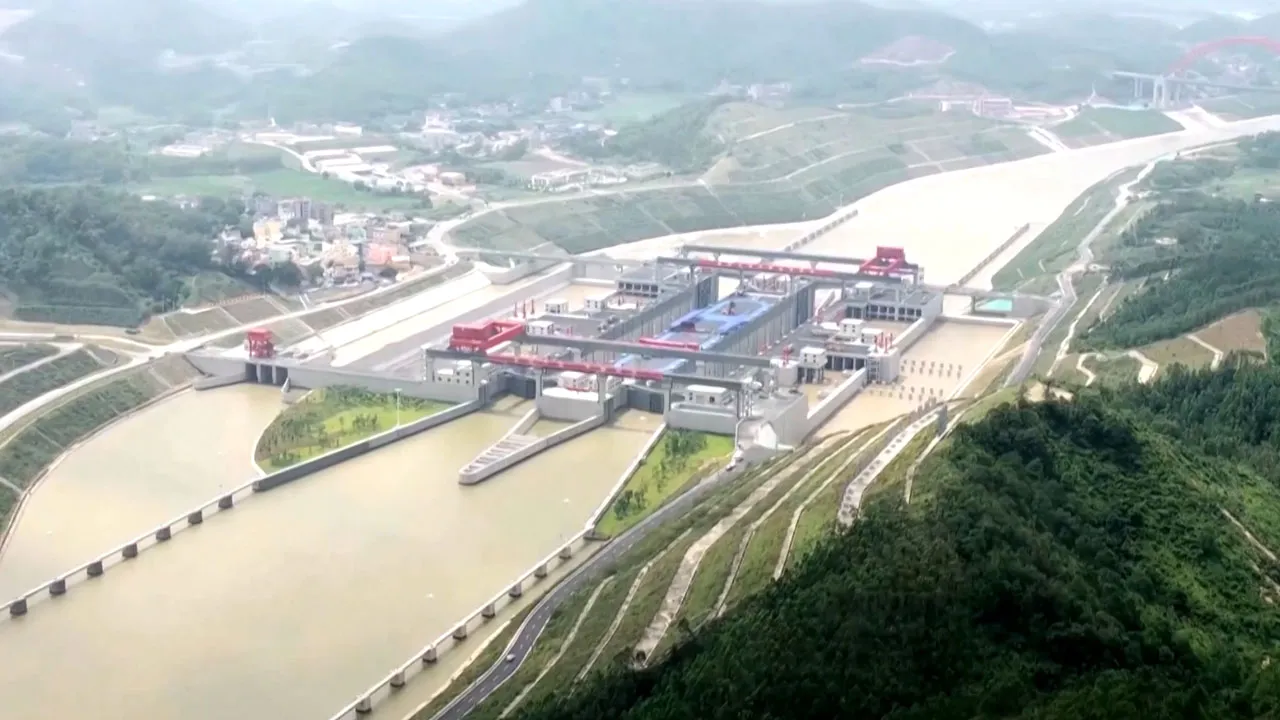
CHINA'S Pinglu Canal opened for navigation on Sept 16 with commercial traffic already organised around it.
Two freight services began on opening day: Nanning–Can Tho in Vietnam and Nanning–Yangpu in Hainan. Before that, Guangxi had held seven cargo-matching sessions involving more than 1,500 cargo owners, shipping companies and freight forwarders, with routes, transport arrangements and first-voyage cargo already being prepared.
The sequence is more revealing than the ceremony.
China is trying to shorten the gap between infrastructure investment and economic productivity.
Every major infrastructure project has a technical commissioning phase. Economic corridors need one as well. Cargo has to be organised, operators connected with customers, rules made workable and companies given commercial reasons to use the route.
Pinglu also shows that this work does not end on opening day. Guangxi is still pushing cargo aggregation, multimodal transport and industrial development around the canal.
Chinese logistics researchers have warned that the harder test will be generating sufficient cargo and persuading shippers to abandon established routes. Infrastructure can create a new option; the market still has to choose it.
Malaysia is approaching the same question with the East Coast Rail Link.
The Kota Bharu–Gombak section is undergoing system-integration and fault-free testing. Operations could begin as early as December if testing and certification proceed smoothly. The Gombak–Port Klang section is scheduled to operate from January 2028.
The commercial timetable matters because ECRL’s business model projects about 70% of operating revenue from freight and 30% from passenger services.
The economic programme around the railway is also becoming more concrete. The government’s latest public estimate puts the ECRL’s cumulative value-added contribution to GDP at RM80 billion to RM90 billion by 2047, driven by 21 Economic Accelerator Projects. Pasir Puteh, Kemaman and Temerloh are among the locations identified for logistics-hub development.
That makes the next phase much larger than filling trains.
The connection with China’s wider logistics system is becoming increasingly explicit. A China–Malaysia Port Alliance publication this year set out plans to upgrade a multimodal system linking “Beibu Gulf Port–Kuantan Port–ECRL–ASEAN hinterland”, taking advantage of the opening of the Pinglu Canal and the ECRL.
Kuantan is one of the clearest places to watch. Beibu Gulf Port Group holds a 40% stake in Kuantan Port. In 2025, a CJ Bio shipment travelled from Kuantan through Qinzhou and then by rail to Chongqing in about 18 days, roughly two weeks faster than its traditional route.
One successful shipment is still only proof that a route can work.
For many containers, remaining at sea will remain cheaper than unloading on Malaysia’s east coast, crossing the peninsula by rail and loading onto another vessel. A past estimate cited by CNA suggested that some sea–rail–sea movements could cost about 12% more than an all-sea route while saving up to 30 hours on particular origin-destination pairs. Singapore retains formidable advantages in sailing frequency and maritime services.
ECRL traffic will have to be won cargo by cargo and route by route.
The larger opportunity begins when those flows change investment decisions inside Malaysia.
If Kuantan Port, MCKIP, Gebeng and the ECRL persuade a manufacturer to place production in Pahang, or a distributor to establish a regional warehouse there, the return extends far beyond rail freight revenue.
Kuantan may be the most visible eastern anchor, but the wider test is whether nodes from Kelantan and Terengganu through Temerloh to the Klang Valley develop complementary economic roles. The latest EAP plans for logistics hubs in Pasir Puteh, Kemaman and Temerloh show that this wider corridor logic is already taking shape.
The same discipline should apply to foreign capital. Malaysia gains more when investment creates local suppliers, engineers, logistics companies, management jobs, processing, services and genuine manufacturing. Rules of origin reinforce the point: simple transshipment alone does not turn foreign goods into Malaysian products.
So the harder measure of ECRL success is this:
How much Malaysian value is created for every unit of capital and cargo entering the corridor?
That is economic commissioning.
Railway engineers are commissioning trains, signalling, power and track. The economy around the railway needs its own preparation: committed freight, workable schedules, industrial tenants, functioning logistics interfaces, Malaysian suppliers and investment decisions made early enough to support the railway’s commercial burden.
Pinglu is useful to Malaysia because it shows both sides of that process. China prepared cargo and commercial activity before the canal opened, yet it is still working to build enough demand after opening.
Malaysia already has many of the pieces. The task now is to make them work as one economy.
A revived Kuala Lumpur–Singapore high-speed railway would eventually raise the same question in a different form, centred more on talent, management and business location than freight.
The ECRL is the test in front of us.
The opening date is approaching. The harder deadline is whether enough economic activity is in place when the trains begin to run.
CW Sim is Chief Strategic Advisor on Greater China, Strategic Pan Indo-Pacific Asia (SPIPA)
** The views and opinions expressed in this article are those of the author(s) and do not necessarily reflect the position of Astro AWANI.