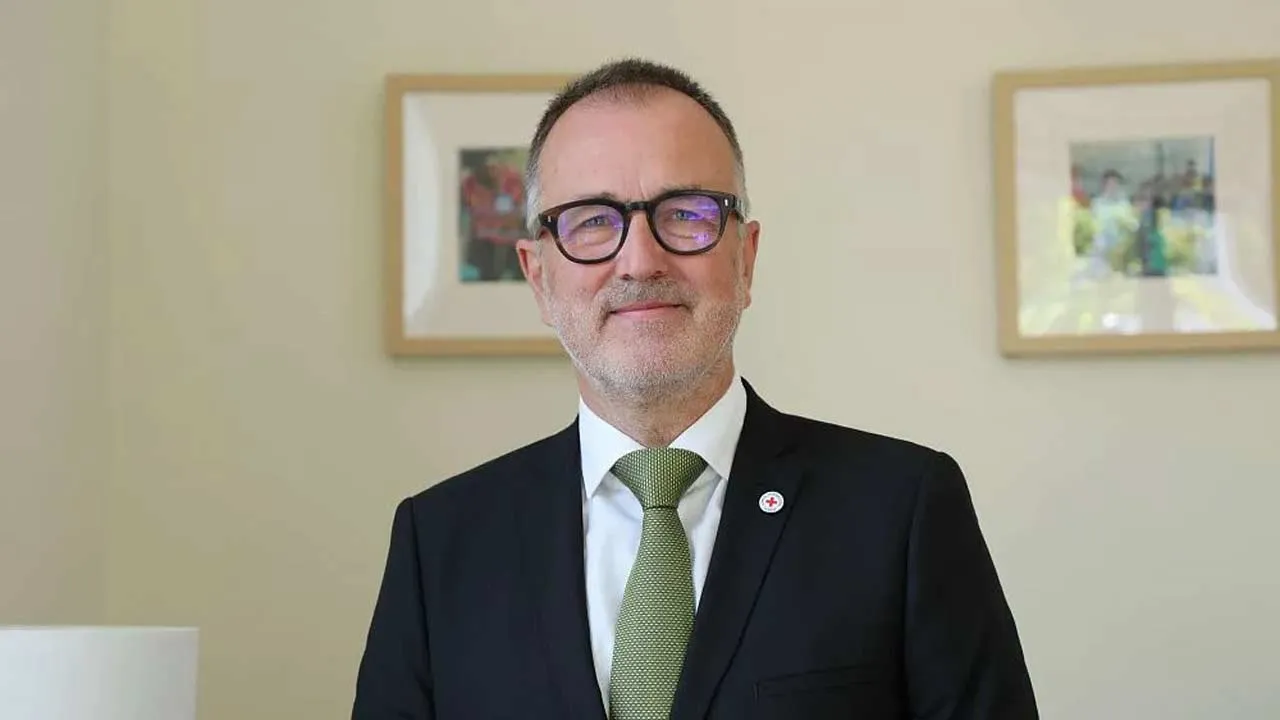
IN an exclusive interview, ICRC East Asia chief Balthasar Staehelin discusses humanitarian cooperation with China, AI in crisis response, BRICS engagement and development partnerships in Africa.
The International Committee of the Red Cross delegation in China marked its 20th anniversary in 2025. How has the organisation’s work in the country evolved over these years? Which areas are now among the key priorities?
First of all, let me mention that the ICRC is a neutral, impartial and independent humanitarian organisation that works across the world to respond to the humanitarian needs of people affected by conflicts and other situations of violence, as well as to promote international humanitarian law. 2025 marked indeed the 20th anniversary of the Beijing delegation, which is of strategic importance for the ICRC as a hub of humanitarian diplomacy in East Asia. The delegation was initially created in 2005 with the overarching objective of building dialogue with the authorities, the Red Cross Society of China, academia, the corporate sector and others, not only to shareour experience in the field of humanitarian response and international humanitarian law, but also to learn and understand the Chinese perspective on humanitarian action, international cooperation and development.
The ICRC acknowledges and values the dialogue it has developed with Chinese counterparts over the past two decades. In the meeting between President Xi Jinping and the ICRC president Mirjana Spoljaric in September 2023, President Xi termed humanitarianism as the greatest consensus among different civilisations. China has proactively raised its voice for the protection of civilians and the respect of international humanitarian law. And very importantly, China is among the six founding States, along with Brazil, France, Jordan, Kazakhstan and South Africa, which, together with the ICRC, launchedtheGlobal International Humanitarian Law Initiative in 2024.
This initiative aims to reinvigorate the international commitment to humanitarian law and promote global compliance and implementation.
Another priority is to continue engaging with relevant international organisations and multilateral platforms, such as the Shanghai Cooperation Organisation, the Beijing Xiangshan Forum, the Boao Forum for Asia, the World Peace Forum.
I must also commend the Red Cross Society of China (RCSC), the ICRC’s principal partner in China. It is among China’s largest humanitarian organisations, always on the frontline to help people affected by different emergencies. The ICRC has worked closely with the RCSC not only in China in terms of emergency preparedness, Humanitarian Education, and promotion of international humanitarian law (IHL) but also internationally. We look forward to building on this.
Personally, it’s been an inspiring experience to have worked in China.
China has been actively developing cooperation with African countries, in particular by investing in the region’s infrastructure, including energy and healthcare, which helps address a number of social challenges. What long-term programmes are currently being implemented on the continent in cooperation with the Chinese office of the International Committee of the Red Cross?
The ICRC recognises the important role that China plays in promoting Africa’s development and stability, particularly within the framework of the Forum on China-Africa Cooperation (FOCAC). Through its long-standing engagement across various African contexts, the ICRC’s humanitarian action contributes in a practical and complementary way to the core objectives of FOCAC, including peace and sustainable development in Africa. The ICRC engages regularly with the Chinese government (MFA and Chinese embassies in Africa), think tanks, the Red Cross Society of China and shares its first-hand observations on certain humanitarian issues on the continent.
It is also worth mentioning that during the past two years, the ICRC regional director for Africa, Patrick Youssef, visited China twice to reinforce our engagements with key Chinese officials, Red Cross Society of China, researchers, the corporate sector and the media on humanitarian challenges in Africa and explore opportunities for strengthened cooperation.
In your view, what role do China’s projects in African countries play in helping the continent achieve the UN Sustainable Development Goals?
First of all, I would like to highlight that development is an area in which China has extensive and significant experience. China’s projects in African countries can play an important role in supporting progress towards the UN Sustainable Development Goals, particularly in areas such as infrastructure or healthcare. Improved infrastructure can enhance access to essential services, facilitate economic development and recovery after crises, and strengthen resilience. Investments in healthcare systems can help expand access to medical care and improve public health outcomes. Thus, China’s development efforts in Africa could also contribute to the improvement of the humanitarian situation.
That’s why the ICRC engages in an active and productive dialogue with China on how to better connect and complement humanitarian aid and development in Africa and in other parts of the world.
If we take the FOCAC Action Plan 2025-2027 as an example, its provisions to promote agricultural and industrial modernisation help contribute to the eradication of poverty and hunger. In terms of cooperation in health, which includes medical aid, health infrastructure and disease eradication, Chinese medical teams contribute to SDG3 on good health and well-being.
It is worth noting that the Action Plan explicitly mentions Red Cross cooperation under the Health and Well-being section. It encourages closer exchanges and cooperation between the Red Cross Society of China and Red Cross and Red Crescent Societies in Africa in the fields of humanitarian assistance, emergency capacity building and community programmes. We highly welcome this.
The International Committee of the Red Cross delegation in China actively engages with local businesses interested in operating in Africa. What are the main objectives of this cooperation?
First of all, as the world’s leading manufacturing hub, China has strong advantages in production and infrastructure development. The ICRC has benefited from these strengths, for example through partnerships with Chinese companies that have developed specialised products such as solar lamps for humanitarian operations. Each year, the ICRC procures substantial volumes of goods and services from China to support its humanitarian operations worldwide, including in Africa.
There are several areas which the ICRC considers promising for cooperation with Chinese companies. First, these companies can provide financial or in-kind support to humanitarian organisations under their CSR programmes. Second, they can partner with local and international actors to deliver essential services, such as water supply or electricity, to affected communities. Third, they can share expertise and knowledge to help improve the effectiveness and reach of humanitarian responses. Finally, they can collaborate with humanitarian organisations to design tailored products that meet specific operational needs.
In terms of concrete cooperation, the ICRC has engaged with Chinese companies through the development of training materials and the organisation of sessions aimed at helping businesses better assess and manage operational risks in challenging environments. This contributes to promoting responsible and secure business practices.
The ICRC has also worked closely with the Alliance of Chinese Business in Africa for Social Responsibilities to strengthen links between corporate social responsibility, sustainable development, and humanitarian impact. The Alliance is a major coordination working mechanism proposed by President Xi Jinping towards China’s engagement with Africa regarding corporate affairs and has close connections with different ministries, major state-owned enterprises (SOE) and embassies in Africa.
In recent years, the Alliance has facilitated visits by its members to ICRC delegations in Kenya and Nigeria, as well as to the logistics support centre in Nairobi. These exchanges have enhanced mutual understanding and opened new avenues for future cooperation.
In 2025, China’s Ministry of Emergency Management announced the large-scale integration of artificial intelligence into its systems for monitoring and responding to natural and man-made disasters. In your opinion, to what extent do these technologies enhance the effectiveness of prevention and response?
Since you mentioned the Ministry of Emergency Management, let me first give you a quick example of our ongoing collaboration with one of the ministry’s entities before explaining the ICRC’s approach towards new technologies.
In 2024, the ICRC together with National Research Centre for Emergency Medicine (NRCEM), a constituent entity of the Ministry of Emergency Management, produced a travelling exhibition aimed at raising awareness of the use of technology in humanitarian action and the risks associated with using these technologies. The exhibition, titled Click to Care: Humanity in a Digital World, has been displayed in different cities across China since July 2025. It will continue touring the country in 2026 and beyond.
Now on the broader issue of new technologies, the ICRC approaches artificial intelligence not as a technology to be feared or celebrated, but as a set of tools that, like any other, can either enhance or complicate human actions and reactions, depending on how, when, and by whom they are used. This issue resonates particularly for me, as in the past, I was at the forefront of developing the institution’s reflections, as the former Director of Digital Transformation and Special Envoy for Foresight and Techplomacy.
The integration of artificial intelligence into disaster monitoring and response systems has significant potential to enhance both prevention and operational effectiveness. AI can improve early warning systems, enable faster identification of risks and more timely responses to disasters. It can also support data analysis, helping authorities better allocate resources and plan interventions. In large and complex contexts, such technologies can increase efficiency and coordination among different actors.
At the same time, for the ICRC, given its specific mandate and the sensitive contexts in which it operates, such technologies cannot be introduced without thorough risk assessment and the development of clear mitigation measures. The data we collect from beneficiaries is often highly sensitive. It cannot be used indiscriminately, including for training AI systems, even if this could potentially improve service delivery. This is rooted in the “do no harm” principle, which requires that humanitarian action must avoid exposing individuals or communities to further risk. If such data were to fall into the wrong hands, it could have serious consequences for the safety, dignity, and even the lives of those we seek to assist and protect. While technological capabilities are advancing rapidly, so too are the capabilities of malicious actors, including hackers and other cybercriminals. This makes the issue particularly sensitive and requires a cautious and responsible approach.
The ICRC developed its AI Policy in 2024, which clearly outlines our principled and ethical stance on the use of AI in our own operations. Today, we use artificial intelligence and other digital tools to support our activities — for example, to improve logistics or enhance healthcare delivery. Like other organisations, we remain acutely aware of the need to build internal expertise and enhance our response, and so we are always interested in understanding how others deal with similar challenges and in learning from best practices and approaches.
That is why ICRC teams in Beijing, Moscow, Luxembourg, Washington, and other locations engage with technology experts, companies, and public authorities. Their work focuses on promoting awareness of the humanitarian implications and concerns of the use of artificial intelligence in conflicts and strengthening the ICRC’s own digital capabilities to ensure that its systems and operations remain neutral, independent, secure, and effective.
China’s rapid technological development, including in the field of artificial intelligence, is particularly noteworthy. The ICRC sees China – its authorities, companies, and experts – as a key interlocutor on issues related to AI and emerging technologies. We seek to strengthen dialogue on key issues such as technology for humanitarian impact, AI in humanitarian action, digital trust, cybersecurity and international humanitarian law, the impact of harmful information, and data protection.
Another recent example of our engagement on tech issues was the organisation of a symposium on the Responsible Use of Technology in Humanitarian Action, on 4-5 December 2025, together with the Center for International Security and Strategy (CISS) of Tsinghua University. At the symposium, we discussed how emerging technologies, including AI, can be applied humanely, ethically, and responsibly in humanitarian contexts.
We also conduct such active dialogue on new technologies in other BRICS countries, such as Russia. For example, prior to my appointment to Beijing, when I held the position of the ICRC’s Director of Digital Transformation and Data, I participated in the St. Petersburg International Economic Forum in 2021, a large-scale international event in which the ICRC participates annually.
Going back to the issue of artificial intelligence and the role of new technologies in the work of humanitarians, people are sometimes surprised to understand the scope and depth of ICRC’s interest in and work on what digitalisation and new technologies mean for us. It is changing the world, and so of course that means we need to understand these instruments, trends, opportunities or challenges, and what they mean for us and for the people we are trying to help.
Developing such solutions cannot be done by humanitarian organisations alone but requires partnerships, support and collaboration by governments, the private sector, academia and civil society, and we engage widely with them in capitals around the world, including Beijing, Moscow, London, Pretoria, Washington and elsewhere.
At the BRICS Summit in Brazil, a declaration was adopted emphasising the importance of digitalisation in achieving sustainable development. To what extent, in your view, is the experience of the group used in addressing global humanitarian challenges?
Let me start from a broader perspective. The ICRC firmly believes that in today’s increasingly polarised world, there is a strong need for new forms of international cooperation to address global humanitarian challenges. As the political landscape continues to evolve, platforms for international dialogue are becoming ever more important, particularly at a time when dialogue and diplomacy are under strain and, in some cases, are being set aside. It is therefore essential for ICRC to remain present in key global forums and talk to all actors. No organisation can operate effectively today without listening to a wide range of perspectives and engaging with diverse stakeholders. In this context, we are striving to strengthen our engagement with platforms such as BRICS in a more systematic manner.
We see BRICS as a format centred around a constructive agenda of jointly addressing global challenges. Its declarations increasingly reflect a broadening scope of issues of global importance, including those related to humanitarian concerns. The ICRC takes note that recent BRICS leaders’ declarations consistently highlight humanitarian crises, address issues such as food security or disaster risk reduction. This is significant, given BRICS stands as one of the most authoritative global associations bringing together key global and regional powers. It has a voice that is listened to widely; what’s more, such points can also translate into practical guidance for the group’s activities.
What we also appreciate, and what I have seen firsthand, is that BRICS as a group shows growing interest in addressing humanitarian issues not only in its declarations but also in practical cooperation formats. These include, for example, the BRICS Disaster Risk Reduction and Management Working Group, which adopted an action plan in May 2025, as well as dialogue platforms such as meetings of BRICS Deputy Foreign Ministers and Special Envoys on the Middle East and North Africa, where humanitarian issues in the region are regularly discussed.
In particular, BRICS countries have accumulated valuable experience in digitalisation, which can be relevant for humanitarian action. In crisis-affected contexts, digital tools can support needs assessments, improve the distribution of assistance, and enhance communication with affected populations. In this regard, continued dialogue between humanitarian organisations and BRICS can help identify practical, context-sensitive approaches to leveraging digital innovation in support of humanitarian objectives.
Today, more and more young people are becoming involved in international humanitarian work. What do you think is driving this trend, and what new contributions can young men and women bring to the work of the ICRC?
As the ICRC’s Institutional Strategy adopted in 2024 says, in an ever-changing world, the ICRC strives to listen to diverse perspectives, build bridges between cultures, religions and humanitarian principles. As part of this commitment to diversity, the ICRC seeks not only to broaden its geographical perspectives, but also generational ones.
In China, for the past 20 years, the ICRC and the Red Cross Society of China (RCSC) have jointly implemented the Humanitarian Education Programme, helping secondary school and university students engage with humanitarian issues through real-life scenarios and ethical discussions. Using interactive teaching methods and case studies, students learn how humanitarian law seeks to protect human life and what it means to make humane choices in difficult circumstances. From its launch in 2005 to the end of 2025, the Humanitarian Education Programme has been implemented in over 700 schools and universities across 70 cities in 16 provinces and municipalities of China, directly engaging more than 300,000 students. In 2020, a new impetus was given to this programme through a joint notification from the RCSC and the Ministry of Education of China to improve and strengthen Red Cross work in schools.
ICRC’s other flagship programme to manifest our commitment to investing in our young generation is our IHL Moot Court competitions worldwide, annually engaging thousands of young students around the topics of humanitarian action and law. Only in China, for example, from 2007 to 2025, more than 4000 students from across China have participated in these competitions.
Let me give you another concrete example of our engagement with the youth in Russia. Since 2025 the ICRC regularly participates in the BRICS Project Lab organised by the Moscow State Institute of International Relations (MGIMO). The Lab is a platform that brings together students to work on practical tasks provided by partner organisations. Within this framework, the ICRC invites students to prepare analytical papers addressing questions that are also explored internally, such as identifying potential areas of cooperation between the ICRC and BRICS and ways to develop this further. This provides a valuable opportunity for the ICRC to harness the energy and creativity of young people in pursuit of humanitarian solutions, while also allowing students to take their first steps in applied policy research and participate in collective work to unlock solutions to humanitarian challenges.
While the ICRC itself does not have volunteers apart from the members of its governance, the broader Red Cross and Red Crescent Movement, particularly National Red Cross or Red Crescent Societies, engages millions of volunteers worldwide, many of them are young. For many, this serves as a pathway into a professional humanitarian career, and it is not uncommon for individuals who began as volunteers to go on to hold senior leadership positions within the Movement.
The ICRC places strong emphasis on staff development, offering a wide range of training opportunities to build the capacities of its younger employees. Roughly two-thirds of the ICRC’s workforce consists of resident staff hired locally, which often includes young people starting their careers in their home countries. In addition, the ICRC provides traineeships and other opportunities for young professionals at the headquarters in Geneva.
Young people bring energy, fresh thinking, passion and a strong desire to contribute to positive change. Their involvement is essential. It is always an investment in preventing any organisation from becoming ossified and instead remaining dynamic and forward-looking. They are often well placed to explore innovative approaches, including the use of technology in humanitarian response.
The International Committee of the Red Cross currently operates in more than 100 countries. In this context, fostering mutual understanding between people from different nations is essential. In your view, what role do cultural and educational exchanges between countries of the Global South play in strengthening friendly ties? How do they contribute to addressing humanitarian challenges?
Of course, cultural and educational exchanges between countries play a critical role in fostering mutual understanding and trust. They help challenge stereotypes and promote a more nuanced understanding of diverse social and cultural contexts.
Cultural and educational exchanges also create opportunities to share practical experiences and approaches. Such exchanges strengthen networks between institutions and professionals, enabling more coordinated and effective responses to shared challenges. All this is also essential for effective collective work to address humanitarian challenges.
In this regard, the International Red Cross and Red Crescent Movement is unique: It is the world’s largest humanitarian network, comprising the ICRC, 191 National Red Cross and Red Crescent Societies with 17 million volunteers, and the International Federation of Red Cross and Red Crescent Societies.
The Movement connects people across the world and across different cultures around one central idea: humanity.
We observe this clearly in our own work every day across the world: between the ICRC’s locally recruited and international staff, our local Red Cross or Red Crescent Movement partners and the communities we work with and for.
At times, our partners also facilitate important exchanges. For example, in August-September 2025, the Training Center of the Chinese Red Cross Society organised a seminar on enhancing the potential of Shanghai Cooperation Organisation member states in the field of humanitarian aid, where colleagues from the ICRC Moscow delegation were also invited, enabling them to meet with counterparts from the Chinese Red Cross, fostering professional ties and personal connections.
Finally, I would like to say that for me as an ICRC delegate with more than 30 years of experience in the humanitarian sector, each mission (and I was working in countries all across the world – in Africa, Middle East, Europe and East Asia) was a unique life and professional experience. It allowed me to work alongside colleagues whose dedication was inspiring and whose diverse perspectives enriched my own way of thinking and my understanding of humanitarian issues. And, of course, it was always an opportunity to experience another culture and meet wonderful people.