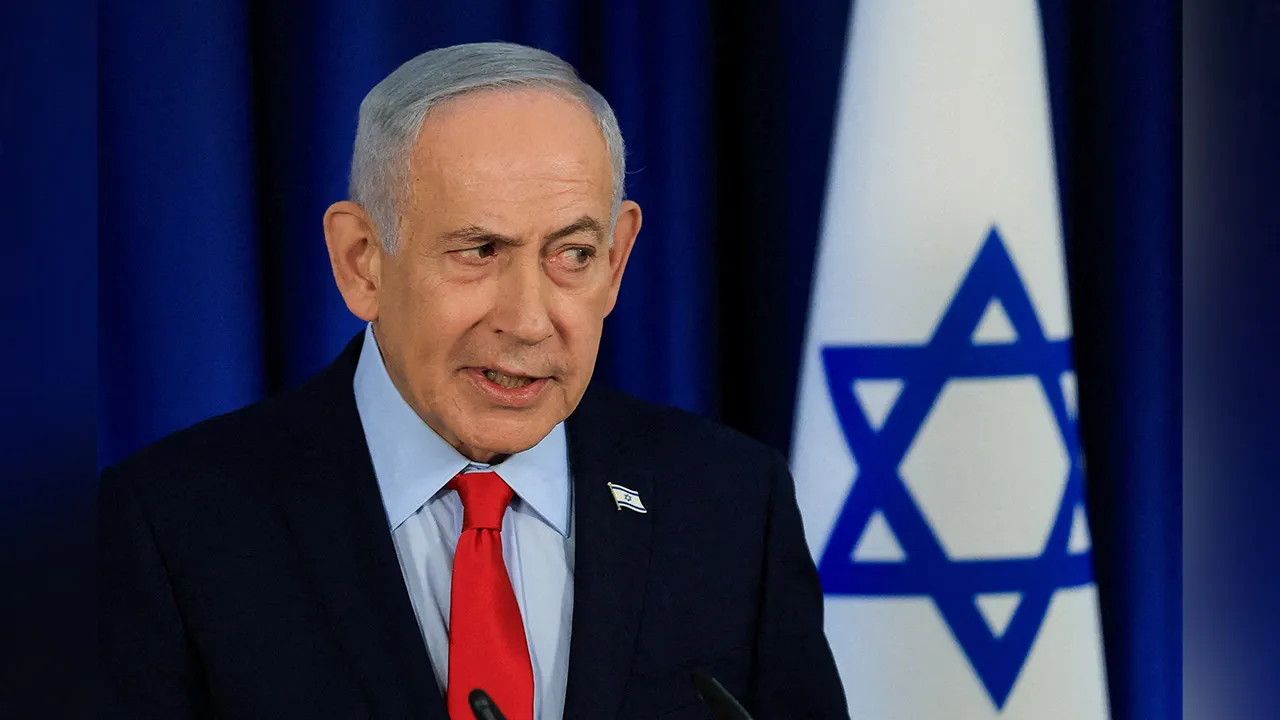
GAZA: Israeli Prime Minister Benjamin Netanyahu recently rejected a U.S.-backed 15-point plan for ending the Gaza conflict, insisting that Israeli forces would not withdraw from Gaza before Hamas is completely disarmed.
Analysts said the rejection, driven by Netanyahu's political and security calculations, casts fresh uncertainty over the Gaza peace process, yet does not necessarily signal the immediate collapse of peace efforts.
MAINTAINING THE STATUS QUO
Netanyahu "benefits from maintaining the status quo," Ramallah-based political analyst Esmat Mansour told Xinhua, arguing that a rapid move to the second phase of the peace plan could force him to make political concessions, particularly an Israeli withdrawal while Hamas remains active.
The U.S.-backed peace framework rests on reciprocal commitments by Israel and Hamas. Hamas had reportedly agreed to address its weapons, on condition that Israel honor its corresponding withdrawal commitments.
Making Hamas' complete disarmament a precondition for Israeli withdrawal could allow Netanyahu to delay the second phase without formally abandoning the agreement, Mansour said.
Aram Kiwan, political analyst and columnist for the Haifa-based Al-Ittihad newspaper, went further to point out that Israel is "trying to change the very basis of implementation" by altering the sequence and conditions of implementation.
Such a change, he said, would give Israel greater control over the timing and conditions of its withdrawal. "The issue is therefore not only disarmament itself, but who determines when the condition has been met."
"If the agreement does not clearly define what constitutes disarmament, who is responsible for verifying it and what timetable applies, the phrase 'complete disarmament' could become an open-ended obstacle," Kiwan said.
Any disagreement over whether the conditions have been fulfilled could return negotiations to their starting point, he warned.
DOMESTIC NEEDS VS U.S. PRESSURE
Netanyahu's rejection also in part reflects the competing political pressures he faces at home and from Washington, according to Aida Touma-Suleiman, an Arab member of the Israeli Knesset.
She told Xinhua that advancing toward the second phase came at a politically difficult moment for Netanyahu, who needs to preserve the support of his right-wing coalition ahead of the October elections while facing pressure from Washington to advance the Gaza peace process.
Netanyahu's right-wing partners, who want to intensify Israeli attacks on Gaza and establish settlements inside the territory, welcomed the prime minister's rejection of the Gaza plan.
At the same time, U.S. President Donald Trump needs to demonstrate progress on the Gaza issue and his broader peace efforts, while substantive movement toward the second phase could place Netanyahu under greater domestic political pressure.
Against this backdrop, analysts said Netanyahu appears to be prioritizing domestic political survival and coalition stability, choosing to resist U.S. demands rather than risk political collapse.
PEACE PROCESS UNDER TEST
Despite the current deadlock, analysts said Netanyahu's rejection does not necessarily signal the agreement's immediate collapse.
The Israeli prime minister has defied past U.S. presidents, analysts said, noting that this approach carries greater risks now as Israel's military campaigns have left it increasingly isolated diplomatically and dependent on U.S. support. Continued U.S. pressure and mediation efforts could eventually push Israel toward gradual implementation despite Netanyahu's hardline rhetoric, Mansour said.
Touma-Suleiman also said Washington could place greater emphasis on practical steps than political rhetoric, leaving room for Netanyahu to maintain a hardline public position while accepting limited measures in practice. The gap between political rhetoric and practical implementation could help keep the agreement alive while negotiations continue, she said.
Ramallah-based political analyst Tamara Haddad said Netanyahu's position amounts in practice to rejecting the second phase in its current form rather than rejecting the concept of a second phase altogether.
She expected negotiations to continue in the short term, with the current phase likely to be extended rather than the agreement collapsing immediately or moving swiftly into the second phase.
Washington's role could prove decisive, she said. If Trump exerts sustained pressure, Netanyahu could accept an interim arrangement that preserves his demand for disarmament while allowing gradual Israeli redeployment.
However, if Netanyahu receives firm U.S. backing for his current stance, the second phase could face deeper obstacles, leaving the agreement as a framework on paper, Haddad warned.