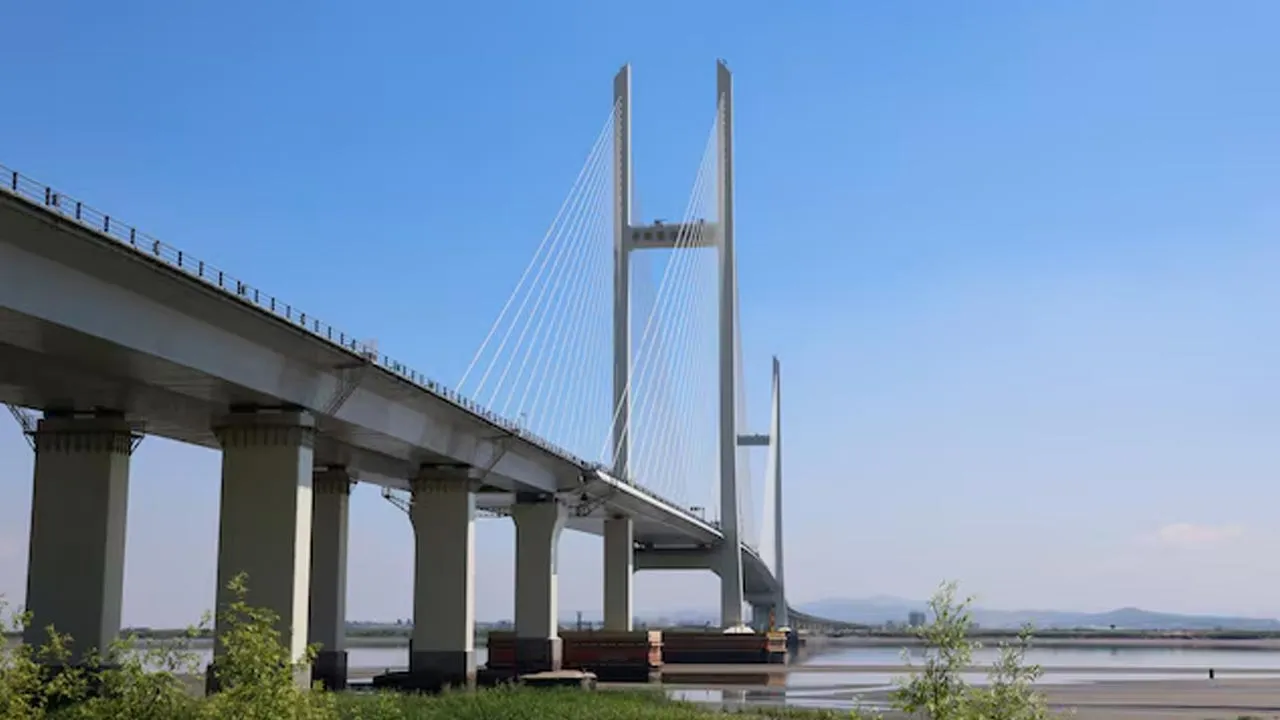
BEIJING: The long-delayed New Yalu River Bridge linking China and North Korea will open on Thursday, Chinese state news agency Xinhua said on Wednesday, signalling a renewed push to boost trade despite Pyongyang's lingering wariness of greater economic dependence.
The two sides will jointly hold an opening ceremony, the Xinhua report said. North Korea's state media did not immediately report on the plan. The bridge will be the largest and most significant land crossing for trade between the two countries.
China completed its side of the bridge in 2014, hoping to boost trade ties, although North Korea left its approach roads and customs facilities unfinished as relations soured over Pyongyang's nuclear tests and the UN sanctions that followed.
The opening of the new bridge signals further progress in bilateral relations between Beijing and Pyongyang, weeks after North Korea opened its first road bridge with Russia. The North's ties with Moscow have advanced rapidly since their leaders' meeting in 2023.
China's exports to North Korea rose to a six-year high of $2.3 billion last year, a 25% increase over the previous year. That was still well below levels before UN sanctions were tightened in 2017.
China and Russia have since questioned the legitimacy of the UN Security Council resolutions that they had voted to pass and have been accused by countries such as South Korea and the US of conducting trade and exchanges in breach of the sanctions.
China is by far North Korea's largest trading partner, but the opening of the new bridge carries added significance as the isolated state expands external exchanges after the pandemic amid Pyongyang's efforts to balance relations with its two key economic and strategic partners.
North Korea and Russia opened a road bridge last month across the Tumen River, adding another transport link as Pyongyang expands economic and strategic cooperation with Moscow.
The 3-km (2-mile) dual-carriageway bridge connects the Chinese border city of Dandong with Sinuiju in North Korea and is intended to replace the ageing, single-lane Sino-Korean Friendship Bridge as the main route for road trade.
Cho Han-bum, a senior research fellow at the Korea Institute for National Unification in Seoul, said further putting off the opening could have been a source of unwanted strains for both, even as Pyongyang remains cautious of greater economic dependence on China.
“There is always both wariness and cooperation in North Korea-China relations,” he said.