
INTERNATIONAL
China’s ‘shared future’ vision gains ASEAN attention amid geopolitical strains, Malaysian official says
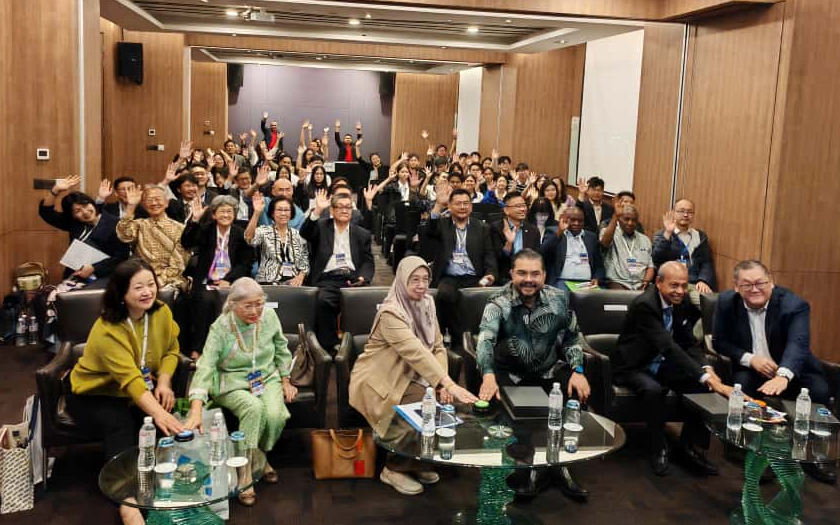
From left: Dato’ Abdul Majid Khan, Prof. Zuraidah Manaf, Datin Paduka Tan Siok Choo. From right: Fairuz Adli, Dennis Seng, Prof. Zhang Yanqiu at the ASEAN–China Shared Future conference. - Malaysia-China Friendship Association
KUALA LUMPUR: China’s vision of building a “community with of shared future” seeks to promote a more inclusive, harmonious and mutually beneficial international order.
Malaysia–China Friendship Association president Dato’ Abdul Majid Ahmad Khan said
China’s rapid rise has reshaped the global balance of power, noting that the United States now views China as the only nation capable of challenging its global leadership across diplomatic, economic and military domains.
Speaking at the “ASEAN–China Dynamics in Building a Shared Future” international conference yesterday, Abdul Majid said the current global environment — marked by geopolitical tensions, economic fragmentation, technological disruption, trade frictions and the escalating impact of climate change — is increasingly described as uncertain and “post-normal”.
“In this context, China’s idea of a shared future is not only about advancing its national interests, but also about promoting a more cooperative model of global governance,” he said.
He added that the concept reflects China’s accumulated experience and insights from four decades of transition from a developing nation into a major global power.
Abdul Majid also recalled that during Chinese President Xi Jinping’s state visit to Malaysia in April, both governments issued the Joint Statement between the People’s Republic of China and Malaysia on building a High-level Strategic Malaysia-China Community with a Shared Future, marking a new direction for bilateral cooperation.
“Broadly, ASEAN member states welcome China’s vision of a shared future, but challenges remain in its implementation,” he said.
He stressed that cooperation must be grounded in mutual respect, sovereign equality and alignment with ASEAN’s core principles. He said progress on a binding and credible South China Sea Code of Conduct (COC) — one that enhances trust and demonstrates China’s commitment to regional stability — together with stronger people-to-people and institutional exchanges, are essential conditions for realising the shared future vision.
The international seminar was jointly organised by the Tun Tan Cheng Lock Centre for Social and Policy Studies (TCLI) of Universiti Tunku Abdul Rahman (UTAR), the ASEAN Research Centre for a Community with Shared Future (UTAR), the Institute for Community with Shared Future of the Communication University of China (CUC), and the Institute of Social Economic Research (ISER) of Tunku Abdul Rahman University of Management and Technology (TARUMT).
A total of 25 academic papers were presented by scholars from China, Malaysia, Japan, Africa, Indonesia, the Philippines and Singapore.
Your gateway to global news, insights, and stories that matter.

Malaysia–China Friendship Association president Dato’ Abdul Majid Ahmad Khan said
China’s rapid rise has reshaped the global balance of power, noting that the United States now views China as the only nation capable of challenging its global leadership across diplomatic, economic and military domains.
Speaking at the “ASEAN–China Dynamics in Building a Shared Future” international conference yesterday, Abdul Majid said the current global environment — marked by geopolitical tensions, economic fragmentation, technological disruption, trade frictions and the escalating impact of climate change — is increasingly described as uncertain and “post-normal”.
“In this context, China’s idea of a shared future is not only about advancing its national interests, but also about promoting a more cooperative model of global governance,” he said.
He added that the concept reflects China’s accumulated experience and insights from four decades of transition from a developing nation into a major global power.
Abdul Majid also recalled that during Chinese President Xi Jinping’s state visit to Malaysia in April, both governments issued the Joint Statement between the People’s Republic of China and Malaysia on building a High-level Strategic Malaysia-China Community with a Shared Future, marking a new direction for bilateral cooperation.
“Broadly, ASEAN member states welcome China’s vision of a shared future, but challenges remain in its implementation,” he said.
He stressed that cooperation must be grounded in mutual respect, sovereign equality and alignment with ASEAN’s core principles. He said progress on a binding and credible South China Sea Code of Conduct (COC) — one that enhances trust and demonstrates China’s commitment to regional stability — together with stronger people-to-people and institutional exchanges, are essential conditions for realising the shared future vision.
The international seminar was jointly organised by the Tun Tan Cheng Lock Centre for Social and Policy Studies (TCLI) of Universiti Tunku Abdul Rahman (UTAR), the ASEAN Research Centre for a Community with Shared Future (UTAR), the Institute for Community with Shared Future of the Communication University of China (CUC), and the Institute of Social Economic Research (ISER) of Tunku Abdul Rahman University of Management and Technology (TARUMT).
A total of 25 academic papers were presented by scholars from China, Malaysia, Japan, Africa, Indonesia, the Philippines and Singapore.
Your gateway to global news, insights, and stories that matter.