STANDING in Dili, surrounded by the physical artifacts of the strife it faced up until 1999, one is struck by a paradox: the young nation of Timor-Leste is trapped in a race against its own clock.
In James Robinson and Daron Acemoglu’s institutional framework, a state achieves sustainable prosperity by walking a “narrow corridor” – a delicate balance between a capable, inclusive state and an active civil society. In Dili, that balance takes a distinct form. Timor-Leste’s struggle is no longer about winning statehood, but about constructing the economic and diplomatic institutions required to keep it.
The Economic Dilemma: Is ASEAN the Way Out?
Timor-Leste’s structural economy faces a critical inflection point. The depletion of its primary oil and gas fields has left the nation dependent on its sovereign Petroleum Fund. Without rapid economic diversification, the fund faces exhaustion within a decade.
Concurrently, Foreign Direct Investment (FDI) remains low outside state infrastructure projects. Investors hesitate due to land title ambiguities, limited domestic market scale, and human capital deficits.
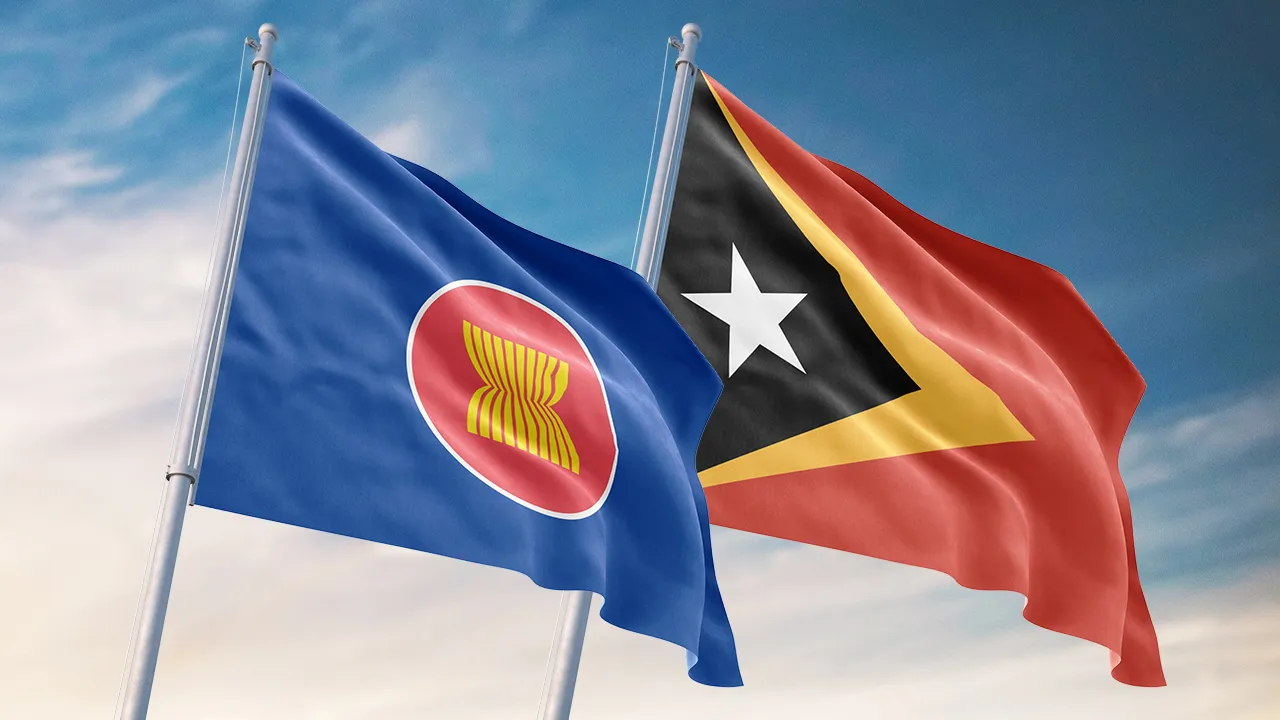
Joining ASEAN is often criticized as a symbolic gesture for a nation of 1.4 million facing immediate fiscal pressures. Critics ask how does joining a free trade grouping benefit a nation that produces little non-commodity output beyond high-grade coffee (coffee that is of exceptional quality but on the scale far too small to think of a consistent export)?
Yet, viewed through the lens of institutional development, ASEAN accession functions less as an instant growth engine and more as an external institutional anchor. It forces regulatory harmonisation – compliance with ASEAN standards compels domestic institutions to streamline legal frameworks, clarify property rights, and reduce administrative bottlenecks. Accession also signals to global capital that Dili is bound to regional dispute-settlement mechanisms, lowering political risk premiums. Finally, ASEAN’s rules based framework serves as a protective layer for a small state like Timor Leste, insulating it from dependency on single powerful neighbours.
Managing Neighbours: The Australian Dispute and Asymmetric Power
Timor-Leste's security strategy is shaped by hard lessons learned in maritime diplomacy, most notably with Australia. Following independence, Dili entered a protracted struggle with Canberra over national boundaries in the Timor Sea, where tens of billions of dollars in oil and gas (including the Greater Sunrise field) hung in the balance.
Australia initially pushed for boundaries based on its continental shelf rather than the international median line standard. The dispute turned bitter in the mid-2000s following revelations that Australian intelligence had bugged Timorese cabinet offices during treaty negotiations.
Rather than resorting to hostility – maybe something that would be expected from larger or more established states – Dili leveraged international law. Timor Leste forced compulsory conciliation hauling Australia before the Permanent Court of Arbitration at The Hague under UNCLOS provisions. In 2018, Australia backed down and signed a historic treaty establishing a permanent median-line boundary, granting Timor-Leste 70 to 80 percent of Greater Sunrise revenues.
This victory proved that rules-based multilateral institutions are a small state’s strongest armour and critical platform to amplify its voice. ASEAN membership extends this logic, embedding Dili within a now eleven-nation grouping so it never has to negotiate key regional terms from a position of isolation.
The position of the Timorese Ministry of Foreign Affairs is that Australia no longer presents a concern in what comes to the gas exploration rights as the situation has been resolved. At the same time Dili reserves its rights to explore cooperation with a wider range of partners, including Russia, even though it has explicitly made known its position on the Ukraine conflict. It refrains from moralising in international politics when its own survival and economic sustenance remain more pressing priorities.
The Pragmatic Reconciliation: Forgiveness as Statecraft
Equally striking is the Timorese posture toward Indonesia. Having lost up to a third of its population during a 24-year occupation, Timor-Leste today treats Jakarta as its paramount regional partner alongside Australia and the US.
This post-war posture reflects a deliberate strategy of realpolitik in approaching geopolitics, memory institutionalisation and strategic forgiveness. Antagonizing Jakarta, its sole land neighbour, would risk its economic interests. The belief of the Timorese government is that turning former adversaries into commercial partners guarantees security far more effectively than military posturing. Not to say vigilance is not in order - neighbouring Indonesia, for one, still faces more of secessionist sentiments in a few regions, therefore it might not mind if the project “Timor Leste” would prove economically unsustainable. Such an outcome could just become a cautionary tale for the other regions contemplating independence.
Through the archives like the Resistance Museum and the Chega! truth commission report, the past (and still fresh) trauma was formally documented. By institutionalising historical memory, the state prevented foreign policy from becoming hijacked by grievance.
Timorese leaders like President José Ramos-Horta and Prime Minister Xanana Gusmão have also adopted a strategic forgiveness approach when trading punitive international tribunals for sovereign survival and the possibility of a rapid economic integration into the Asia-Pacific.
Walking the Corridor Forward
Timor-Leste’s path mirrors the core thesis of Why Nations Fail – another book by Acemoglu and Robinson which official translation to Tetun was officially launched in Dili in August: inclusive political choices dictate long-term trajectories.
By choosing democratic continuity over authoritarian governance, legal multilateralism over bilateral confrontation, and regional integration over isolationist bitterness, Timor-Leste has carved out its space in the narrow corridor. The challenge now is building domestic institutional capacity before its petroleum safety net fully recedes.
The walk through this corridor remains highly uncertain at this point – with the framework for protecting foreign investment incomplete, the lack of high developed human capital and its ability to bring a few industries – coffee included – to the scale that could cope with export.
The National University of Timor Leste (UNTL) with its 30,000 active students is hard at work on supplying the cadres for science and tech as well as effective governance. However, with the GDP per capita of USD1,341 as of 2025, the country still requires a clear vision and tremendous effort to reach that light at the end of the corridor, proving that the project “Timor Leste” graduated from a struggle for sovereignty to a truly independent state.
Dr Julia Roknifard is a Senior Lecturer at the Bachelor’s Program in Philosophy, Politics, and Economics (PPE) at the School of Law and Governance, Taylor’s University. She writes the piece on the heels of the study trip to Timor Leste undertaken by Taylor’s University in August 2026.
** The views and opinions expressed in this article are those of the author(s) and do not necessarily reflect the position of Astro AWANI.