
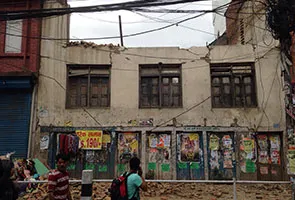
The magnitude 7.9 earthquake that hit Nepal today not only left more than 900 people dead but also almost wiped out several centuries old buildings in the capital Kathmandu and surrounding areas.
Not only that, 34 people were reported to have died in India due to the temblor.
The authorities also warned that the worst is not over yet with 21 aftershocks reported with some measuring between 5.5 and 6.5 on the Richter scale.
The Indian Meteorological Department (IMD) which closely monitors seismic movements in the region said the situation was still not safe for residents to move back into their houses and buildings (in the disaster zone).
Officials here also warned the public that minor shockwaves will last for nearly a month.
Aftershocks were also felt in this capital with some the residential areas reporting power failure for more than an hour.
PHOTO GALLERY: Nepal earthquake
The media reported that thousands of people in Kathmandu were still gathered on major streets with rescue officers, mostly army personnel and volunteers, using their limited resources in carrying out search and rescue operations.
TV channels here are carrying 24-coverage with footage showing people with broken limbs and arms being rushed in for treatment to hospitals in Kathmandu.
It was unclear how many people were injured, but five Malaysian embassy staff and their family members were reported safe.
In term of damage to buildings, the historic Dharahara Tower built in the 19th century in Kathmandu collapsed, trapping at least 200 people.
READ: Death toll from Nepal earthquake passes 1,000
Nepal police were quoted as saying that the tower had been open to visitors for the last 10 years and had a viewing balcony on its eighth floor. TV stations showed visuals of dead bodies being removed from the site.
In related developments, among the first countries responding to support Nepal and its people was India, whereby the Indian Prime Minister Narendra Modi assured that his country will not assist in search and rescue operations but will support its neighbour to get back on its feet as soon as possible.
Within hours, two Indian Airforce aircraft landed at the Kathmandu International Airport carrying nearly 300 National Disaster Response Force (NDRF) volunteers and 50 tonnes of medicine and essential of foods.
Earlier, seventeen helicopters which were sent to the disaster areas, were forced to return to their bases in India due to bad weather.
All commercial flights into Nepal are being diverted to other cities in India to facilitate international rescue team arrivals.
READ: Deadliest earthquakes of the past 30 years
Meanwhile, the airport is reported will reopen for commercial flights tomorrow briefly to facilitate stranded foreigners to return to their respective countries.
The earthquake also triggered massive avalanches, up to 7pm local time here, army rescue teams had already retrieved 18 bodies from Base Camp 1 and 2 of the Mount Everest.
Army officials confirmed most of them were foreigners and some 15 climbers were still reported missing.
Out of the 34 casualties in India, 25 of them are from the state of Bihar.
Indian officials estimate the number to escalate further with some of remote areas still not accessible.