
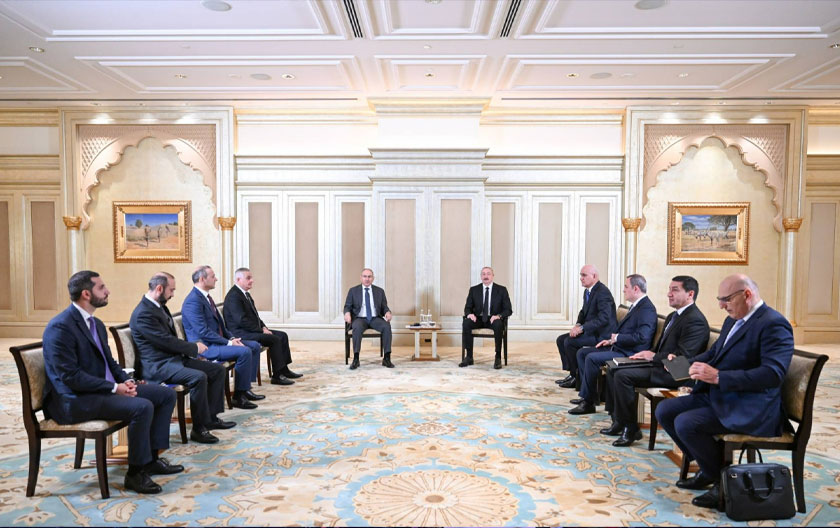
ON July 10, one of the most significant meetings in the history of Armenian-Azerbaijani relations took place in Abu Dhabi. The negotiations were held strictly in a bilateral format. Only the official delegations of Baku and Yerevan were at the table, with no intermediaries from international institutions or major powers.
AI Brief
First, there was a meeting between the delegations of the two countries, led by their heads of state. Afterwards, a personal meeting between the two leaders took place. According to sources close to the negotiations, the talks between the leaders and delegations of the two countries were conducted in a very positive, businesslike, and constructive atmosphere, with a focus on results. This was also evident from the published video materials. Despite the absence of breakthrough decisions, the meeting itself became a crucial milestone in shaping the post-war order and new transport-logistics architecture of the South Caucasus. It is important to emphasize that this was the first official bilateral meeting of the two leaders since they agreed on the draft text of the peace agreement.
The significance of this meeting lies not only in its agenda but also in its format. Against the backdrop of the ineffectiveness of previous formats, which were overloaded with geopolitical interests, the rejection of mediation underscores the growing agency of both Baku and Yerevan. For the first time in three decades, the conflicting parties are engaging without imposed frameworks—from the OSCE Minsk Group to collective initiatives by the EU or Moscow. The parties are increasingly consciously moving towards direct bilateral dialogue. Such an approach reduces and leaves less room for external pressure. It is also important to note that this negotiation format has already yielded results. For example, as a result of this format, 12.7 km of the state border has been delimited and demarcated, and all points of the peace treaty have been agreed upon. This indicates that the peace settlement process between the two countries is gradually taking the shape that official Baku has aimed for. Now, the parties themselves, without imposed decisions, conduct dialogue and seek a path to sustainable peace.
Speaking about the importance of this meeting, it should be emphasized that Azerbaijan has clearly outlined several key principles, and against this background, the current negotiations can be seen as another confident step towards a comprehensive peace agreement. After restoring its territorial integrity, Baku has repeatedly put forward peace initiatives based on transparent and widely recognized international standards. These proposals have not only gained approval from the international community but, more importantly, have resonated in Yerevan, resulting in this meeting. At the same time, Azerbaijan maintains a firm position on the need to amend Armenia’s constitution, which still contains territorial claims, and insists on the final dissolution of the OSCE Minsk Group, which has lost its relevance in the new realities. Thus, the Abu Dhabi meeting is not a final point but a significant milestone on the challenging road to the long-awaited peace.
Why Abu Dhabi?
The choice of the UAE capital to hold key negotiations was a carefully calculated and strategically justified step by Azerbaijan. The Emirates are known for their balanced, stable, and pragmatic foreign policy, based on respect for state sovereignty and international law norms. The UAE is not involved in the conflict, does not take anyone’s side, and serves as a truly neutral and friendly platform for dialogue. This creates optimal conditions for respectful communication, constructive discussion, and focus on real results. It is also significant that the initiative to hold the meeting came directly from Baku, and the choice of Abu Dhabi was a natural continuation of Azerbaijani foreign policy aimed at concrete and practical achievements.
Focus on the Peace Agreement and the Zangazur Corridor
Undoubtedly, the issue of the Zangazur corridor and the unlocking of transport communications in the region was not just one of the topics of the meeting—it was its pulse, the key vector on which the future of the entire region depends. This is not an ordinary infrastructure project but a potential turning point in the historical inertia of the South Caucasus.
For Azerbaijan, it is a step towards the long-awaited restoration of ties with the Nakhchivan exclave, expanding its strategic space and creating new economic arteries. For Armenia, it is a rare chance to break out of the cycle of isolation, gain direct access to the markets of Turkey, Azerbaijan, Central Asia, and Europe, and connect to international trade and transit routes. It is important to note that the opening of the Zangazur corridor could transform Armenia’s status from a country trapped in chronic conflicts into an active player and one of the main beneficiaries of the new regional reality in the South Caucasus.
External Forces Hindering Peace Become Evident Even to Armenia
It should be added that, although Armenia has begun to recognize the presence of certain external forces hindering peace, many still cling to old scenarios on the path to change. Both within Armenia and beyond its borders, many influential forces strive to preserve the status quo, fearing the loss of their leverage and control. Mainly, these forces are the radical part of the Armenian diaspora, the Armenian Apostolic Church, and the opposition. All these forces hinder any attempts at rapprochement between Baku and Yerevan. Their rhetoric and actions are openly aimed at disrupting the reform course and destabilizing the situation.
Prime Minister Nikol Pashinyan has increasingly spoken openly about external pressure aimed at regime change and attempts to interfere in Armenia’s internal affairs. However, it is noteworthy that these attempts are now beginning to be recognized even within Armenia. Opposition to the peace process from certain states and actors causes concern even in Armenian society, which is tired of confrontation and eager for normalization. More and more people realize that the path to stability and development lies not through isolation but through cooperation and openness. This new mood can become decisive and give a chance for the long-awaited breakthrough for which such difficult negotiations are being held.
Armenia Demonstrates Readiness for Peaceful Coexistence
Prime Minister Pashinyan’s rhetoric in recent months increasingly signals changes in Armenia’s regional outlook. Armenia is increasingly aware of the new reality with a clear strategy of peace and development. The formula for peaceful coexistence proposed by President Aliyev, based on mutual recognition of borders, renunciation of territorial claims, and restoration of economic ties, is gradually turning from a political initiative into the foundation of a future peace treaty.
It is particularly significant that the Abu Dhabi meeting was neither a coincidence nor a diplomatic ritual. It is a logical link in a well-thought-out sequence of steps aimed at forming a stable, predictable, and secure South Caucasus. Despite internal pressure and resistance from radical forces, Pashinyan demonstrates readiness for dialogue and a conscious political choice in favor of peace. All this indicates Armenia’s growing political will to engage in new regional processes, where the main priority is not confrontation but finding real points of contact and mutual benefit.
Conclusion
The Abu Dhabi meeting was far more than just another item on the diplomatic agenda. It was a moment of truth—when two leaders met face to face, free from external dictates or pressure, on a neutral and trustworthy platform. They confronted not just a formal task but a genuine opportunity to lay a solid foundation for lasting peace, close the chapter on a long-standing conflict, and open the door to stability and development for the entire region. President Ilham Aliyev reaffirmed his commitment to a strategy centered on peace, dialogue, and mutual recognition. Prime Minister Nikol Pashinyan, in turn, displayed political maturity and readiness to embrace a new reality where the foremost priorities are the interests of his people and long-term security.
Today, the South Caucasus stands at the threshold of a new chapter—one defined by cooperation, openness, and confidence in the future. The Abu Dhabi meeting clearly demonstrated that the fate of the region lies in the hands of its own states. Peace is no longer an abstract dream but a tangible prospect, beginning with direct, honest dialogue devoid of intermediaries and foreign agendas. Everything hinges on political will, responsibility, and an understanding of this historic moment. In conclusion, the Abu Dhabi meeting has presented the South Caucasus with an opportunity it cannot afford to miss.
Fuad Abdullayev is a research fellow at the Center for Analysis of International Relations (AIR Center) in Baku, Azerbaijan.
** The views and opinions expressed in this article are those of the author(s) and do not necessarily reflect the position of Astro AWANI.
Your gateway to global news, insights, and stories that matter.

AI Brief
- Armenia and Azerbaijan held their first direct official meeting in years, signaling a shift toward self-led peace efforts without external mediation.
- Both sides discussed key issues like finalising a peace treaty and opening the Zangazur Corridor, vital for economic ties and regional stability.
- Despite internal opposition, Armenia is increasingly aligning with Azerbaijan's peace roadmap, aiming for cooperation over conflict.
First, there was a meeting between the delegations of the two countries, led by their heads of state. Afterwards, a personal meeting between the two leaders took place. According to sources close to the negotiations, the talks between the leaders and delegations of the two countries were conducted in a very positive, businesslike, and constructive atmosphere, with a focus on results. This was also evident from the published video materials. Despite the absence of breakthrough decisions, the meeting itself became a crucial milestone in shaping the post-war order and new transport-logistics architecture of the South Caucasus. It is important to emphasize that this was the first official bilateral meeting of the two leaders since they agreed on the draft text of the peace agreement.
The significance of this meeting lies not only in its agenda but also in its format. Against the backdrop of the ineffectiveness of previous formats, which were overloaded with geopolitical interests, the rejection of mediation underscores the growing agency of both Baku and Yerevan. For the first time in three decades, the conflicting parties are engaging without imposed frameworks—from the OSCE Minsk Group to collective initiatives by the EU or Moscow. The parties are increasingly consciously moving towards direct bilateral dialogue. Such an approach reduces and leaves less room for external pressure. It is also important to note that this negotiation format has already yielded results. For example, as a result of this format, 12.7 km of the state border has been delimited and demarcated, and all points of the peace treaty have been agreed upon. This indicates that the peace settlement process between the two countries is gradually taking the shape that official Baku has aimed for. Now, the parties themselves, without imposed decisions, conduct dialogue and seek a path to sustainable peace.
Speaking about the importance of this meeting, it should be emphasized that Azerbaijan has clearly outlined several key principles, and against this background, the current negotiations can be seen as another confident step towards a comprehensive peace agreement. After restoring its territorial integrity, Baku has repeatedly put forward peace initiatives based on transparent and widely recognized international standards. These proposals have not only gained approval from the international community but, more importantly, have resonated in Yerevan, resulting in this meeting. At the same time, Azerbaijan maintains a firm position on the need to amend Armenia’s constitution, which still contains territorial claims, and insists on the final dissolution of the OSCE Minsk Group, which has lost its relevance in the new realities. Thus, the Abu Dhabi meeting is not a final point but a significant milestone on the challenging road to the long-awaited peace.
Why Abu Dhabi?
The choice of the UAE capital to hold key negotiations was a carefully calculated and strategically justified step by Azerbaijan. The Emirates are known for their balanced, stable, and pragmatic foreign policy, based on respect for state sovereignty and international law norms. The UAE is not involved in the conflict, does not take anyone’s side, and serves as a truly neutral and friendly platform for dialogue. This creates optimal conditions for respectful communication, constructive discussion, and focus on real results. It is also significant that the initiative to hold the meeting came directly from Baku, and the choice of Abu Dhabi was a natural continuation of Azerbaijani foreign policy aimed at concrete and practical achievements.
Focus on the Peace Agreement and the Zangazur Corridor
Undoubtedly, the issue of the Zangazur corridor and the unlocking of transport communications in the region was not just one of the topics of the meeting—it was its pulse, the key vector on which the future of the entire region depends. This is not an ordinary infrastructure project but a potential turning point in the historical inertia of the South Caucasus.
For Azerbaijan, it is a step towards the long-awaited restoration of ties with the Nakhchivan exclave, expanding its strategic space and creating new economic arteries. For Armenia, it is a rare chance to break out of the cycle of isolation, gain direct access to the markets of Turkey, Azerbaijan, Central Asia, and Europe, and connect to international trade and transit routes. It is important to note that the opening of the Zangazur corridor could transform Armenia’s status from a country trapped in chronic conflicts into an active player and one of the main beneficiaries of the new regional reality in the South Caucasus.
External Forces Hindering Peace Become Evident Even to Armenia
It should be added that, although Armenia has begun to recognize the presence of certain external forces hindering peace, many still cling to old scenarios on the path to change. Both within Armenia and beyond its borders, many influential forces strive to preserve the status quo, fearing the loss of their leverage and control. Mainly, these forces are the radical part of the Armenian diaspora, the Armenian Apostolic Church, and the opposition. All these forces hinder any attempts at rapprochement between Baku and Yerevan. Their rhetoric and actions are openly aimed at disrupting the reform course and destabilizing the situation.
Prime Minister Nikol Pashinyan has increasingly spoken openly about external pressure aimed at regime change and attempts to interfere in Armenia’s internal affairs. However, it is noteworthy that these attempts are now beginning to be recognized even within Armenia. Opposition to the peace process from certain states and actors causes concern even in Armenian society, which is tired of confrontation and eager for normalization. More and more people realize that the path to stability and development lies not through isolation but through cooperation and openness. This new mood can become decisive and give a chance for the long-awaited breakthrough for which such difficult negotiations are being held.
Armenia Demonstrates Readiness for Peaceful Coexistence
Prime Minister Pashinyan’s rhetoric in recent months increasingly signals changes in Armenia’s regional outlook. Armenia is increasingly aware of the new reality with a clear strategy of peace and development. The formula for peaceful coexistence proposed by President Aliyev, based on mutual recognition of borders, renunciation of territorial claims, and restoration of economic ties, is gradually turning from a political initiative into the foundation of a future peace treaty.
It is particularly significant that the Abu Dhabi meeting was neither a coincidence nor a diplomatic ritual. It is a logical link in a well-thought-out sequence of steps aimed at forming a stable, predictable, and secure South Caucasus. Despite internal pressure and resistance from radical forces, Pashinyan demonstrates readiness for dialogue and a conscious political choice in favor of peace. All this indicates Armenia’s growing political will to engage in new regional processes, where the main priority is not confrontation but finding real points of contact and mutual benefit.
Conclusion
The Abu Dhabi meeting was far more than just another item on the diplomatic agenda. It was a moment of truth—when two leaders met face to face, free from external dictates or pressure, on a neutral and trustworthy platform. They confronted not just a formal task but a genuine opportunity to lay a solid foundation for lasting peace, close the chapter on a long-standing conflict, and open the door to stability and development for the entire region. President Ilham Aliyev reaffirmed his commitment to a strategy centered on peace, dialogue, and mutual recognition. Prime Minister Nikol Pashinyan, in turn, displayed political maturity and readiness to embrace a new reality where the foremost priorities are the interests of his people and long-term security.
Today, the South Caucasus stands at the threshold of a new chapter—one defined by cooperation, openness, and confidence in the future. The Abu Dhabi meeting clearly demonstrated that the fate of the region lies in the hands of its own states. Peace is no longer an abstract dream but a tangible prospect, beginning with direct, honest dialogue devoid of intermediaries and foreign agendas. Everything hinges on political will, responsibility, and an understanding of this historic moment. In conclusion, the Abu Dhabi meeting has presented the South Caucasus with an opportunity it cannot afford to miss.
Fuad Abdullayev is a research fellow at the Center for Analysis of International Relations (AIR Center) in Baku, Azerbaijan.
** The views and opinions expressed in this article are those of the author(s) and do not necessarily reflect the position of Astro AWANI.