
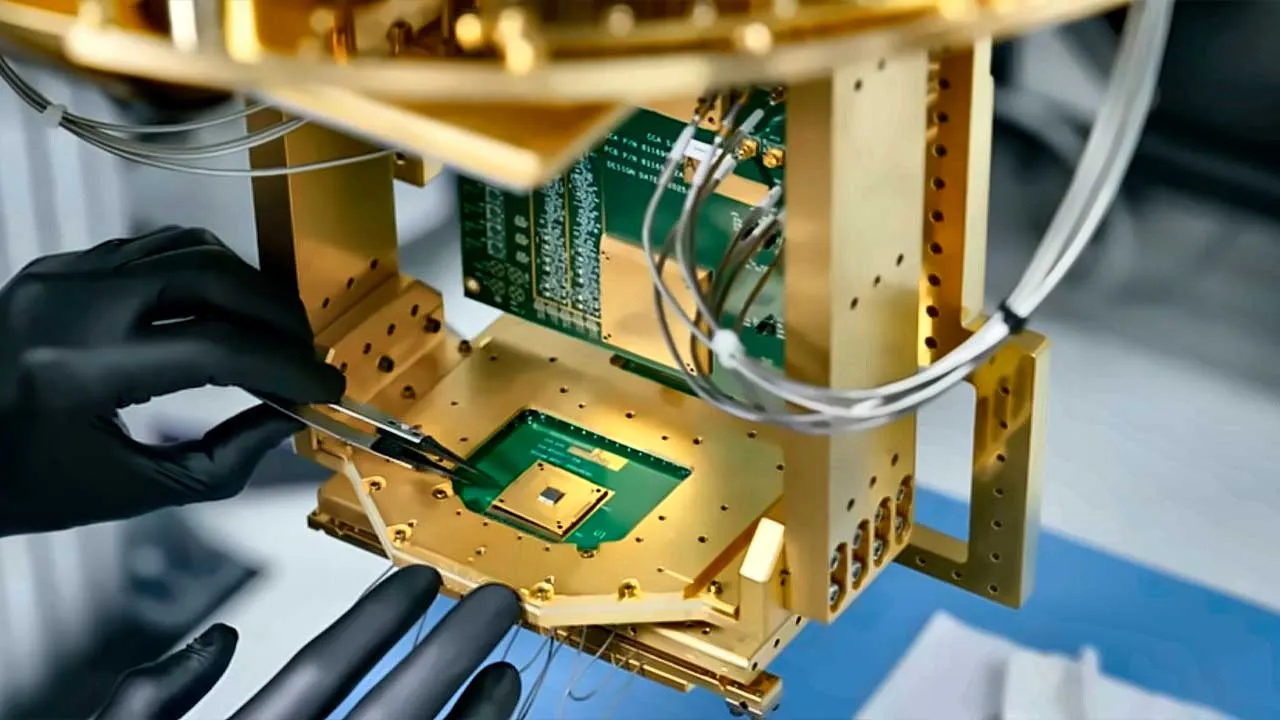
LOS ANGELES: Quantum computing is unlikely to drive the kind of resource-intensive data centre expansion now being fuelled by artificial intelligence, according to Thaddeus Ladd, chief scientist of the Computational Physics Division at HRL Laboratories.
Ladd said quantum computers would have important applications, but largely in specialised fields rather than across the broad consumer economy.
“I think the answer is going to be no,” Ladd said when asked whether quantum computing could eventually become as resource-intensive an industry as AI.
Quantum computers use principles of quantum physics to process certain types of information in ways that could make them more efficient than conventional computers for some complex problems. The technology remains in development, with researchers working to overcome challenges including errors, scalability and the difficulty of operating quantum systems.
Ladd was speaking to media during a reporting tour organised by the U.S. Foreign Press Center, titled “The Next Frontier: How American Innovation Powers Global Commerce”, which examines emerging technologies and their role in economic activity.
He said potential quantum applications included simulating molecules for materials development and helping researchers design metals with improved properties.
“These are things that are going to be important for large companies that make airplanes and data centres and other products,” he said.
But Ladd said such applications were unlikely to generate the same level of direct consumer demand as AI.
“There’s not going to be nearly as much direct-to-everyday-consumer interest,” he said.
By contrast, Ladd said AI could benefit a much wider range of industries, helping explain the scale of investment in the computing infrastructure needed to develop and deploy AI systems.
“In contrast, if you look at AI, everybody in the world stands to gain something from AI,” he said.
That broad potential has contributed to a rapid expansion of AI-related data centre infrastructure, accompanied by rising demand for electricity, water and other resources.
Ladd said quantum computing was unlikely to require a comparable build-out.
“It’s going to be a truly commercial product. It’s going to fit into existing data centres and be a negligible addition,” he said.
Rather than replacing conventional computing infrastructure, quantum systems are likely to operate alongside it for specialised workloads, he said.
Ladd was also asked whether advances in quantum computing could eventually reduce the amount of energy and infrastructure required for computing.
He said that was possible but not yet something that could be assumed.
“I would love to give you that answer, that quantum computers are going to be so powerful that they’re going to allow data centres to be fewer and smaller,” he said.
“I would love to give you that answer. Very, very happy if I could believe it.”
Such an outcome would be desirable, he said, but describing it as a certainty would amount to “very wishful thinking”.
Quantum computers could eventually provide major gains for particular computational problems, but their overall energy impact will depend on how the technology develops and how it is integrated with conventional computing systems.
Ladd’s comments come after IBM completed its acquisition of HRL Laboratories.
IBM said on Aug. 26 that it had completed the acquisition, bringing HRL’s research capabilities in quantum computing, quantum sensing, advanced communications, electronics, manufacturing and materials science into IBM.
The deal combines IBM’s work on superconducting quantum computers with HRL’s research into silicon-spin qubits.
IBM said HRL also brings expertise in quantum sensing, quantum materials, cryogenics, control electronics, packaging and interconnect technologies.
The acquisition forms part of IBM’s effort to develop increasingly capable quantum systems and build the manufacturing and supporting technologies needed to scale them.
IBM has said its roadmap includes IBM Quantum Starling, a fault-tolerant quantum computer targeted for 2029. The company says Starling is expected to perform 100 million quantum operations and provide substantially greater computational capability than current quantum systems.
IBM has said Starling will be followed by Blue Jay, a next-generation fault-tolerant quantum computer targeted for the mid-2030s.
HRL's silicon-based quantum research could also complement IBM's efforts to develop scalable quantum manufacturing, including through Anderon, IBM's quantum wafer foundry.
Boeing and General Motors, which previously owned HRL, are expected to continue working with IBM and HRL on quantum applications and advanced technologies.
The acquisition reflects the growing involvement of major technology companies in developing quantum hardware, manufacturing and applications as researchers seek to move the technology from laboratory systems toward commercial use.