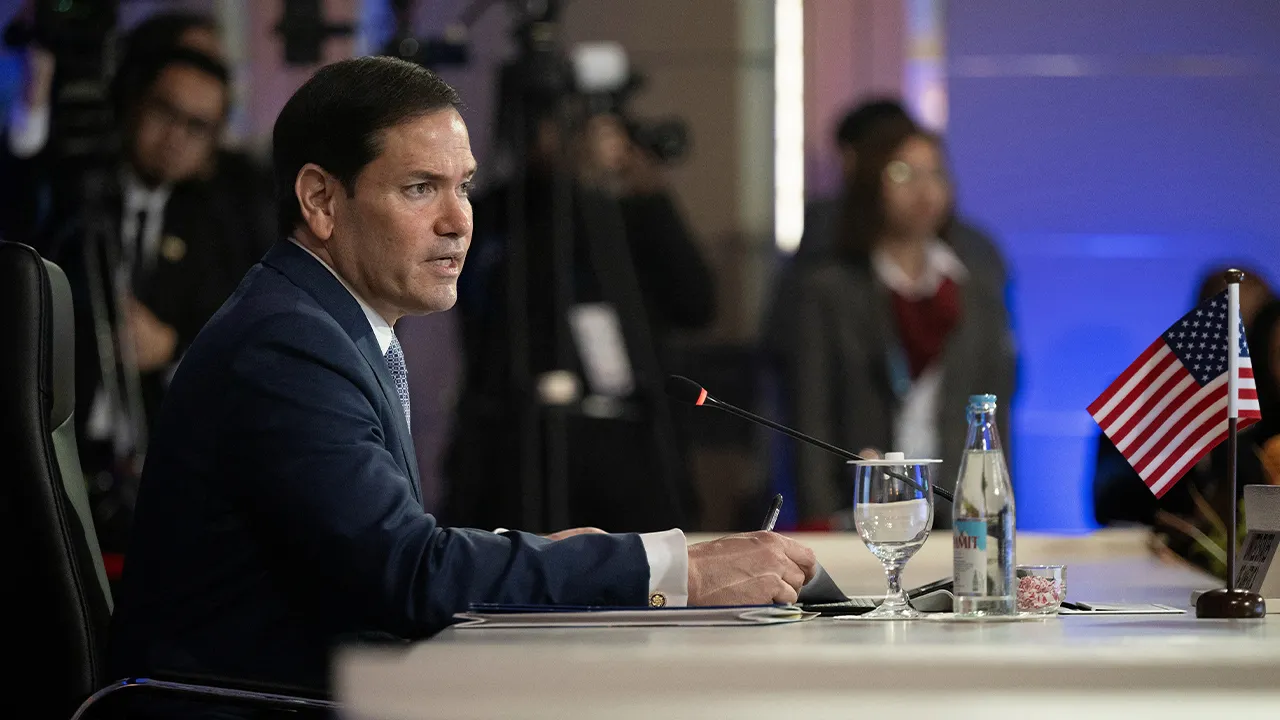
DUBAI/MANILA: U.S. Secretary of State Marco Rubio said on Wednesday the United States is still willing to negotiate an end to the Iran crisis but Tehran is not serious about talks, as the widening conflict disrupted two of the world's most critical energy chokepoints.
Rubio made his comments in a meeting of Southeast Asian foreign ministers a day after three oil tankers carrying Saudi crude to Asia reversed course in the Red Sea, apparently in response to threats from Yemen's Iran-aligned Houthis.
The Houthis, who control the coast at the mouth of the Red Sea, announced a naval blockade on Saudi Arabia on Monday, opening a potential new front in the war which has killed thousands of people across the Gulf since it began on February 28 with U.S. and Israeli attacks on Iran.
With Iran already threatening shipping through the Strait of Hormuz leading out of the Gulf, the Red Sea has served as the main alternate route out for millions of barrels of Saudi oil per day.
A senior Iranian official told Reuters on Monday that Tehran had received a proposal from mediators for a 10-day ceasefire in efforts to salvage the interim ceasefire agreement signed by the U.S. and Iran in June, which replaced an earlier April ceasefire.
In another sign that diplomacy remains alive, Iran's Interior Minister Eskandar Momeni has visited mediator Pakistan and asked Islamabad to continue its efforts.
Rubio said Washington was "always committed to diplomacy" but doubted whether Tehran was equally committed to negotiations.
"The problem we're having right now is that they're not serious about talks. If they're serious, we're serious. If they're not, then we will do what's necessary to protect our interests, and also the interests of our allies," Rubio said in Manila.
He stressed that Iran could not be allowed to control the Strait of Hormuz, arguing it would create a dangerous precedent for the world including Southeast Asian countries, many of which have territorial disputes in the South China Sea with China.
"If we create a precedent in the Middle East where a nation state can decide that they are going to control an international waterway, charge a toll, and if you don't pay them blow up your ships, we have created a very dangerous precedent, which will repeat itself in other parts of the world, including in this region," Rubio said.
With no diplomatic breakthrough in sight, the U.S. military bombed targets across Iran for an 11th straight night on Tuesday. Tehran residents reported hearing explosions in the early hours of Wednesday as Iran activated its air defences over the capital, Iran's semi-official Fars news agency said.
Three locations in Iran's Bushehr Province, home to Iran's only nuclear power plant, were hit by U.S. attacks early on Wednesday, an official told Iran's state news agency IRNA, including an electricity post close to the plant.
Iran's army said it targeted U.S. military facilities in Kuwait, Jordan and Bahrain with drones early on Wednesday. The army said it struck accommodation buildings and equipment storage facilities at Al Azraq air base in Jordan, and later targeted equipment warehouses and aircraft maintenance hangars at Sheikh Isa Air Base in Bahrain using Arash suicide drones.
Reuters was unable to immediately verify details of the attacks.
U.S. President Donald Trump confirmed that 18 U.S. service members had been killed so far in the war, including four in Iranian attacks on U.S. military bases in Jordan and Iraq over the last few days.
Oil prices rose further in Asian trade on Wednesday after climbing more than 2% on Tuesday following the Houthi threats, with Brent crude hovering above US$91 a barrel and U.S. gasoline back over US$4 a gallon.
"GATE OF TEARS"
In a letter to shippers, the Houthis on Tuesday threatened to attack any ships that load or discharge Saudi oil.
Trump said the Houthis had not yet shut the Bab el-Mandeb, the "Gate of Tears" strait leading into the Red Sea, and threatened to act against them if they did.
"So far it hasn't happened," Trump said. "If something like that happens, we take care of it."
Three oil tankers loaded with Saudi crude for China and India made U-turns in the Red Sea on Tuesday, heading towards the Suez Canal rather than braving the Yemeni coast at the sea's mouth.
Throughout the war, Saudi Arabia partially escaped the shipping disruption by piping oil to Yanbu on the Red Sea instead. But a full closure of that alternative route by the Houthis could reduce global oil supply as it would leave most Saudi oil exports trapped.
On Tuesday, Trump renewed his threats to again attack Iran's nuclear facilities at Natanz "pretty soon", which he said in June 2025 had been "totally obliterated" after the U.S. military bombed the facility, buried in a mountain range, that month. Iran promised it would retaliate.
Fifty civilians have been killed and 500 wounded in the recent U.S. strikes on Iran, a health ministry official said.