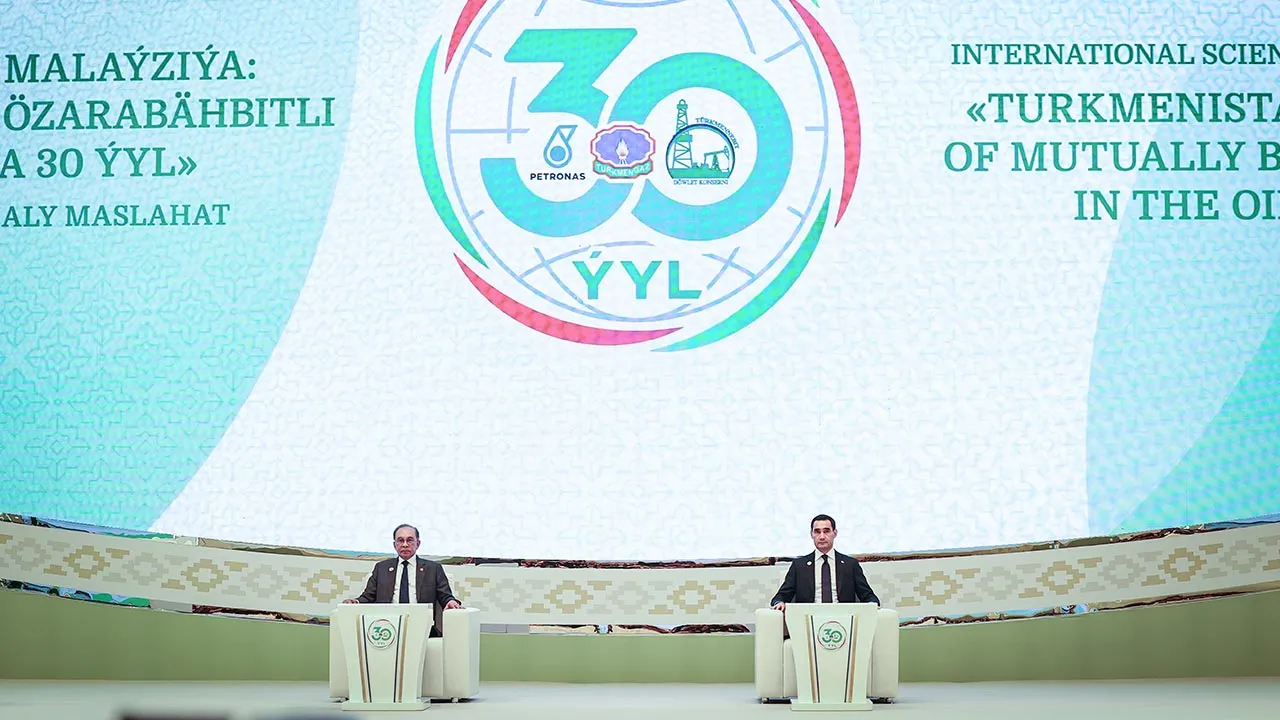
If the “killing two birds with one stone” idiom is politically incorrect especially with animal rights activists, killing three would be a howler even without references to monkeys! Now, semantic sensitivities aside, that’s exactly how I would describe Prime Minister Anwar Ibrahim’s recent lightning trip to Kazan and Ashgabat preceded by a stopover in Tashkent.
The trip is vital and opportune because the international economic order is fast undergoing one of its most pivotal periods of transformation since the end of the Cold War. Strategic competition among major powers is intensifying. Trade restrictions, sanctions, export controls, and industrial policies have become increasingly common instruments of statecraft.
For countries such as Malaysia, the implications are profound. It is not just about securing growth within an open global economy, or simply about protecting critical supply chains. It is about preserving economic opportunities, strategic autonomy, and national resilience in an environment that is becoming more contested, fragmented, and uncertain.
Against this backdrop, the Prime Minister’s diplomatic foray to Tashkent, Kazan, and Ashgabat, which took only four days, is of enormous economic consequence. Taken together, they offer an important insight into how
Malaysia’s economic diplomacy is diversifying, and adapting to a changing international landscape, and how soft power as ensconced in the personality of leaders is indispensable to clinching deals.
A Wider Network of Partnerships
In many respects, the visits reflected different facets of the same strategic objective. In Tashkent, a scheduled stopover, preplanned for a mere courtesy meeting with President Shavkat Mirziyoyev, morphed into a working visit with discussions on several major areas of economic cooperation that had been initiated from the previous official visit in 2024, with some key deliverables to be completed, where the devil is always in the details.
In Kazan, Malaysia participated in the ASEAN-Russia Commemorative Summit and engaged with political and business leaders from across the wider Eurasian region. In Ashgabat, attention focused on the deepening of Malaysia’s longstanding energy partnership with Turkmenistan. Yet all the engagements pointed towards a common theme: the widening of Malaysia’s economic partnerships in response to a more complex global environment.
This approach reflects a broader reality confronting many middle powers today. As economic and technological competition intensifies, resilience increasingly depends not merely on burgeoning trade numbers or even GDP statistics, but also on the breadth and diversity of a country’s external relationships.
Yet diversification is not a byword for displacement. Expanding engagement with new partners does not diminish the importance of existing ones. Rather, it reflects an effort to widen Malaysia’s economic options in an increasingly challenging world. For a trading nation whose wealth creation depends on openness and connectivity, Malaysia’s resilience will thrive on a wider network of mutually beneficial ties.
This is particularly relevant as the global economy gradually evolves towards a more multipolar configuration. Countries that successfully position themselves within a broader range of economic networks are likely to enjoy greater flexibility and resilience than those whose options remain narrowly concentrated.
The discussions in Kazan reflected many of these realities. While Russia remains a relatively modest trade and investment partner for ASEAN compared to several other major economies, both sides recognise untapped opportunities in sectors ranging from energy and agriculture to digital technologies, advanced manufacturing, and food security.
More importantly, the summit highlighted ASEAN’s continuing effort to engage a diverse range of external partners while preserving its strategic autonomy. This has long been one of ASEAN’s defining strengths: centrality, its perceived constraints notwithstanding. Centrality warrants that rather than viewing regional affairs through exclusive blocs or binary choices, ASEAN consistently seeks to maintain open channels of engagement across competing centres of influence.
The ASEAN-Russia Strategic Programme on Trade and Investment Cooperation 2026 – 2035 reflects this approach. The document clearly demonstrates a recognition that future competitiveness will increasingly depend upon innovation, technological capability, and economic adaptability.
Equally significant were discussions between Malaysia and the Republic of Tatarstan. Although often overshadowed by Moscow in external perceptions of Russia, Tatarstan has emerged as one of the country’s most dynamic industrial and technological centres. Conversations covered opportunities spanning biotechnology, halal industries, maritime capabilities, Islamic finance, and industrial cooperation.
Such engagements illustrate a crucial but often overlooked dimension of contemporary economic diplomacy. National governments are no longer the sole gateways to economic cooperation. Increasingly, regions, provinces, cities, industrial clusters, and specialised innovation hubs have become important actors in international economic networks. Building relationships with these centres can often generate practical opportunities that complement traditional state-to-state diplomacy.
Energy as a Strategic Imperative
The last-leg visit to Turkmenistan highlighted another critical dimension of diversification: energy diplomacy. For three decades, PETRONAS has maintained a significant presence in Turkmenistan. Over that period, it has evolved beyond the role of a foreign investor. Its operations have contributed
to infrastructure development, technological advancement, skills transfer, and human capital development. The scale of investment, estimated at nearly US$12 billion, reflects a partnership built patiently over many years rather than a recent search for alternative markets.
The landmark agreements concluded by Petronas during the visit suggest that this relationship is, in the words of President Serdar Berdimuhamedov himself, “entering a new critical phase,” perhaps an understatement considering its enormous economic consequence. In point of fact, the deals have effectively given Petronas a huge stake in one of the world’s largest gas fields, cementing long-term cooperation in hydrocarbon development, new production-sharing arrangements, and expanded exploration activities.
This is a deep commitment by both sides to strengthen energy cooperation which extends beyond commercial considerations. Recent geopolitical crises have demonstrated how quickly disruptions in one part of the world can affect energy markets, transportation networks, and production costs elsewhere. In such circumstances, diversified partnerships become an absolutely vital component of economic resilience and strategic flexibility.
Yet it would be a mistake to view these engagements solely through the lens of trade and investment statistics, an overarching theme consistently stressed by PM Anwar, in all bilateral discussions.
Economic diplomacy today increasingly operates across multiple domains simultaneously. Questions of food security intersect with technology. Energy cooperation overlaps with industrial development and infrastructure
investment. Digitalisation creates opportunities for innovation while raising concerns about standards, governance, and technological dependence. Above all, the consolidation of “brotherly relations” is now considered to be part of the stock-in-trade of economic diplomacy, to build mutual trust and confidence, where soft power is sine qua non, the art of the deal for that final hand-shake.
This explains why discussions in Tashkent, Kazan, and Ashgabat extended beyond purely commercial matters. Collaboration in education and research, the halal ecosystem, and financial services featured prominently. Increasingly, these areas are no longer peripheral to economic relations but have become central pillars of national competitiveness. And on that subject, the fact that Malaysia now ranks 15th among 70 countries in World Competitiveness Ranking for 2026, having jumped eight spots, is not to be sniffed at.
For middle powers such as Malaysia, this requires a broader conception of diplomacy itself. Foreign policy can no longer be viewed solely as a mechanism for managing political relationships. It must also serve as a platform for securing economic opportunities, strengthening resilience, supporting technological upgrading, expanding national strategic options, and, of course, people-to-people relations. Not all clichés are clichéd!
Diversification with Purpose
The challenge, however, is not merely to diversify. Diversification without strategy risks producing a collection of disconnected initiatives. The weightier task is to identify partnerships that complement Malaysia’s long-term development priorities, whether in advanced manufacturing, food security, or emerging technologies.
Call it a hat trick or a home run, but ultimately, the significance of the Prime Minister’s recent engagements lies less in any individual agreement than in what they reveal about Malaysia’s broader response to a changing world.
Malaysia’s answer appears to be neither alignment nor isolation. Instead, it is to expand the range of partnerships available to the country, preserve strategic autonomy, and create greater room for manoeuvre in an uncertain era.
In the years ahead, being the largest economies or even the greatest power may not be the sure-fire formula for success. On the other hand, the country best positioned to succeed may well be that with the broadest networks, the widest options, and the greatest ability to engage constructively across an increasingly diverse and competitive international landscape. And that is miles and miles to go before we sleep.
- Datuk Prof Dr Mohd Faiz Abdullah is Chairman of the Institute of Strategic and International Studies, Malaysia
** The views and opinions expressed in this article are those of the author(s) and do not necessarily reflect the position of Astro AWANI.