WHEN the town hall in Limoges caught fire on October 17, a movement that began with complaints about schooling took on a different political turn. A burning public building commands attention more readily than the grievances that came before it.
For France’s far right, the image offers an opening to recast protests about failing public services as an argument for nationalist rule. Whether this reframing succeeds will depend on whose explanation of the unrest voters find convincing.
From school grievances to street violence
The mobilisation began in September at the Saint-Exupéry high school in Créteil, on the outskirts of Paris, and soon spread nationwide. Teacher shortages and inadequate facilities gave students concrete reasons to protest. Beneath those complaints lay a deeper anxiety: whether public education still offers a credible path to future opportunities.
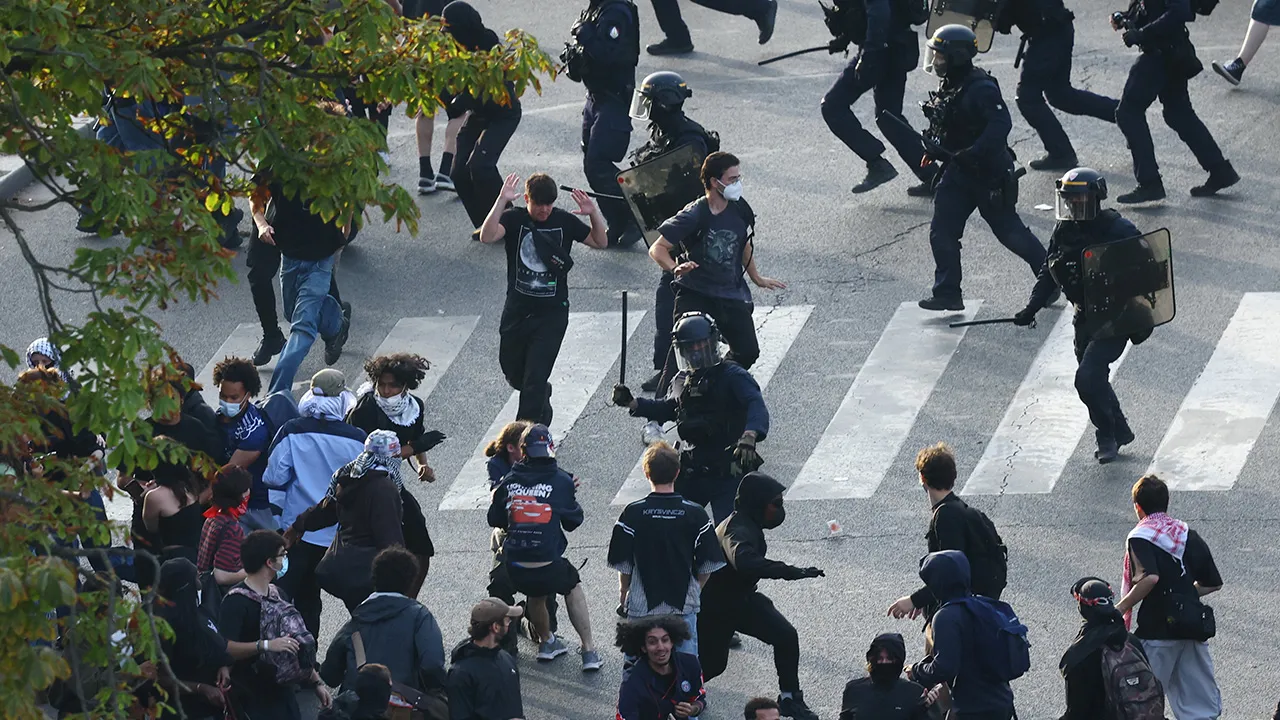
As trade unions and other demonstrators joined, the agenda widened to include the rising cost of living, declining purchasing power, inequality, and inefficient public services. Most participants marched peacefully, even as violent groups attacked buildings, looted shops, and confronted police. The distinction matters. Treating the entire mobilisation as criminal would erase the grievances that gave it public resonance.
Escalation nonetheless changes what a movement can achieve. Destruction invites tougher policing, injuries deepen resentment, and each new demonstration carries the burden of earlier confrontations.
France’s suspension of stun grenades after a teenager suffered a devastating hand injury shows how policing itself became part of the dispute. This does not imply that the police alone caused the violence. This shows how the state’s response can become a grievance in its own right.
Prime Minister Sébastien Lecornu has blamed far-left groups and criminals for the disorder. This attribution deserves scrutiny rather than mere acceptance. Governments have an obvious responsibility to isolate violent participants, but framing a broad social crisis mainly as a security emergency risks narrowing the space for negotiation.
Different triggers, a shared crisis of credibility
Across Europe, the parallels are striking, but the connections should not be overstated in this context. There is no evidence that these protests are branches of a single, coordinated uprising. Belgium offers the clearest case of direct inspiration from France: students protesting education costs and access clashed with police in Brussels, and Liège saw mobilisation.
Elsewhere, domestic grievances were decisive. In Milan, a demonstration against war and living costs descended into looting and clashes that set the capital of fashion on fire.
In Lisbon, protests centred on housing and household expenses. Meanwhile, in Albania, student protests over education and employment merged with anger over corruption and calls for Prime Minister Edi Rama’s resignation. Different triggers produce a common result: a challenge to the credibility of those who govern.
Why unrest does not reward every nationalist equally
Because grievances are national, their political consequences differ, and position matters as much as ideology. An opposition party can blame those in power for their failure. A nationalist party that is already in office must defend its record.
Italy illustrates this point. Giorgia Meloni condemned the violence in Milan, but the demand for affordable living also tests her government’s performance. Ideological affinity with Europe’s nationalist opposition offers no immunity from domestic accountability.
Political Mileage, Uncertain Victory
France presents the most immediate electoral opportunities. Marine Le Pen announced her presidential candidacy after a July appeals ruling shortened her electoral ban while upholding her conviction over the misuse of European funds; she is pursuing a further appeal. Jordan Bardella, a president of the National Rally, remains her intended prime minister should she win France’s Presidential Election scheduled for April and May 2027.
For the National Rally, the unrest offers a chance to pair economic protection with a promise of restored authority. Images of disorder could raise the salience of security, erode confidence in incumbents, and push mainstream rivals toward harder positions.
Yet, attention does not automatically become support, and support does not guarantee victory in France’s two-round presidential election. Voters may distrust both the government’s performance and the National Rally’s remedies.
In the case of Germany, this may point to further constraints: finishing first does not necessarily secure power. The AfD won the September elections in Saxony-Anhalt but fell short of a parliamentary majority. Electoral strength and access to power remain separate achievements. However, to this point, the unrest has not yet reached major cities in Germany.
Nonetheless, French unrest could still supply the German far-right with material for arguments about elite failure, even without a comparable protest movement at home. This is a possibility, not an established consequence.
When Discontent Becomes a Politics of Blame
The more corrosive risk is that economic discontent will turn into a contest over identity politics. Selectively circulated footage can detach violence from its context and attach it to claims about immigration, failed integration or Islam.
Arguments about scarce housing and public resources that favour native-born citizens could redirect frustration towards minority communities. Thus, a debate about institutional capacity becomes an accusation that certain groups receive undeserved protection or resources. Muslims, immigrants, and violent offenders, fundamentally different groups, are folded into a single, threatening category.
Religious identity remains a potent excuse for narrating threat perceptions. Le Pen’s renewed defence of a public headscarf ban in July shows that religious identity remains available to her movement as a political modality. This does not show that she has invoked it to explain this unrest.
On the other hand, on a social-media platform such as Threads and X, irresponsible users attribute the unrest in major European cities to immigrants or Muslims.
Therefore, the danger lies in the mechanism, not in the proof that it is already at work. If blame takes this form, it would deepen alienation while leaving the underlying failures in education, housing, and public administration unaddressed.
Two scenarios for the next six to 12 months
Based on these trends, there are two plausible scenarios worth considering when anticipating political risks caused by unrest in Europe.
Scenario one: disorder becomes an electoral asset. Repeated violence, failed negotiations, and visible divisions within governments push security above economic redress. Far-right parties gain wherever voters accept their claim to restore control, and mainstream parties may absorb parts of that agenda before any electoral transfer of power occurs.
Indicators would include recurrent clashes, rising public concern about security, increasingly exclusionary rhetoric, and shifts in coalition cooperation. Political risk extends beyond damaged property.
Hardened social divisions could obstruct compromise, while uncertain alliances delay reform and make policy commitments less dependable. Investors might postpone decisions if disruption persists, although such effects should be demonstrated rather than assumed. If this is the scenario, Europe will see the return of fascism, as in the post-World War I period.
Scenario two: Grievances regain priority. Credible negotiations, targeted policy relief, and accountable policing reduce confrontation. Eventually, education, housing, and purchasing power return to the centre of public debate. Far-right opposition parties face closer scrutiny of their economic proposals, while incumbents remain accountable for delivery. Indicators would include negotiated settlements, fewer violent incidents, and polling that ranks household welfare above security.
Even this outcome carries risk. Relief measures compete with other spending commitments, coalition partners may disagree over taxation and funding, and promises that exceed administrative capacity could invite renewed disappointment.
Who answers the anger?
Europe’s governments will be judged by whether restoring order is followed by credible improvements in the services and living conditions that brought people to the streets. If these grievances remain unanswered, the far right will have more room to turn public frustration towards minorities and portray exclusion as a remedy for institutional failure.
This political shift need not wait for an election victory. It can begin when mainstream parties adopt the same language of blame as the extremists. The immediate task is to contain violence. The enduring test is whether governments can address the failures that make scapegoating persuasive and effective.
Rizal Hamdan is a Senior Program Officer at Merdeka Centre. He writes about geopolitics and foreign affairs for RIMAU Geopolitical Insights on Substack. The views expressed here are his own.
** The views and opinions expressed in this article are those of the author(s) and do not necessarily reflect the position of Astro AWANI.