Henry Kissinger could pause any war. He kept the peace only once.
THERE is a photograph I have found myself thinking about these past days. It was kept at the Institute of Strategic and International Studies, the Malaysian think tank I would, many years later, have the privilege to serve, and it carries Henry Kissinger's autograph. He had passed through long before my time and signed it in his own hand, nothing more, no flourish. A man who filled libraries with his sentences, who could talk for hours and argue for decades, left only his autograph, and I have never quite been able to square that small, exact courtesy with the ledger of his record. Both are true at once. That, in the end, is the difficulty of the man.
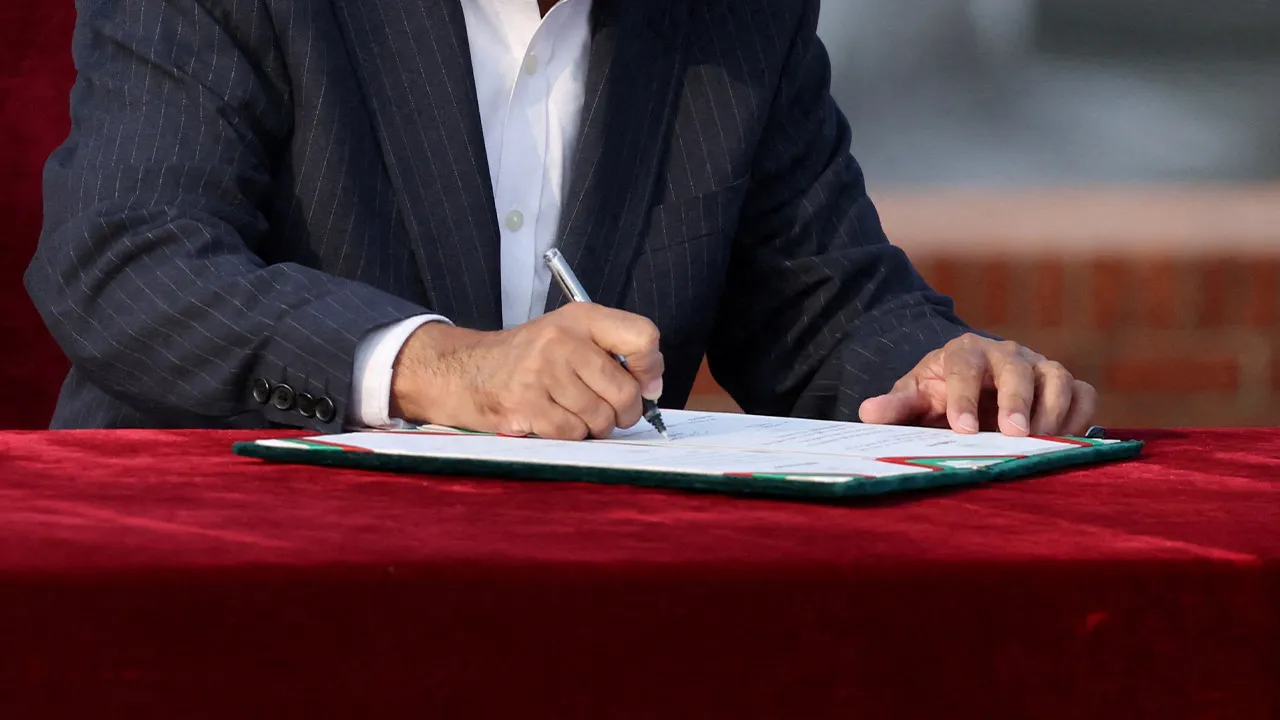
Peace, I argued in this space last week, is a habit and not an event, and a memorandum signed at a dinner table in Versailles is the beginning of the work, not the proof of it. In the days since, Kissinger's name has kept returning to me, and perhaps the photograph is the reason. He understood the art of pausing a war better than almost anyone who ever lived, and his long, contested life is the clearest lesson I know in the distance between silencing the guns and keeping the peace. He died in 2023, at a hundred. Watching President Trump sign his page and a half with Iran, I felt I knew exactly how the old realist would have read it: admiring the craft, distrusting the hope. He usually did.
I hold no brief for Kissinger. Much of what I believe about peace was formed in opposition to what he practised. But it is precisely because he stands on both sides of the argument I am making, and because that bare autograph on the wall keeps drawing me, against my better judgement, into the enigma of the man who left it, that he is worth summoning here.
The master of the pause
Consider the instrument itself. The shuttle diplomacy I praised last week, the patient carrying of positions back and forth until two enemies' inch closer, was, in its modern form, his invention. After the war of October 1973, he flew for months between Jerusalem, Cairo and Damascus, prising apart armies that had just been at each other's throats. The disengagements he produced held. When I admire the quiet shuttle work of middle powers today, honesty obliges me to admit that I am admiring a craft perfected by the very kind of great power broker I am otherwise wary of.
But the same man gives us the definitive example of paper that pauses and does not keep. In 1973 he negotiated the Paris accords that ended America's war in Vietnam, and for them he shared the Nobel Peace Prize. His North Vietnamese counterpart declined the honour; two members of the Nobel committee resigned in protest. Two years later, Saigon fell. The prize remains one of the most uncomfortable in the award's history, proof that a signature, a ceremony and a medal can all certify a peace the ground will not hold. If the JCPOA taught us that a document is only as durable as the next administration's will, Paris teaches the harder lesson: that a document can be perfectly sincere on the day it is signed and still rest on a fiction about what comes after.
The relationship he did build
And yet to leave it there would be to tell only half the story, and the other half cuts against my own argument, which is why I cannot ignore it.
The opening to China was not a document. It was a relationship, and it was built the slow way: a secret flight in 1971, a presidential visit the year after, then decades of careful tending by people on both sides who understood that two civilisations with every reason to remain enemies might instead become something more useful to each other. Kissinger returned to Beijing for half a century, the last time as a private citizen of a hundred, still received as a man who had helped build something real. How alive that inheritance remains was on the world's screens only last month. When President Trump walked the Temple of Heaven beside Xi Jinping this May, he became the second sitting American president to do so, half a century after Gerald Ford in 1975, on a visit Kissinger had helped to arrange. The footage of the two leaders on that ancient ground travelled everywhere, and Beijing framed the new understanding between them, in its own rendering, as an enduring stability that carried the promise of peace. A single secret flight in 1971 had become, more than half a century on, the frame within which a Chinese leader and an American president could still walk side by side and speak of peace at all. Whatever one thinks of where that relationship now stands, it endured as the Paris accords never could, because it rested on mutual interest patiently constructed rather than on terms imposed and signed.
So the realist proves my point and complicates it at once. Even the supreme transactionalist achieved permanence only on the rare occasion when he stopped transacting and began to cultivate. The China opening is the exception that confirms the rule, and, I suspect, the work of the same small instinct for the personal that once moved him to set his name, by hand, on a photograph in Kuala Lumpur.
The cost of order without humanity
Here I must turn to the harder part of the account, because no honest reckoning with this man can skip it, and for me it is not an abstract reckoning. The philosophy that produced the China opening also produced Cambodia, where a secret bombing campaign helped clear the ground for catastrophe; a hand in the fall of Chile's elected government in 1973; a deliberate silence as slaughter unfolded in what became Bangladesh; and a quiet green light for the invasion of East Timor.
I do not raise these names from a library. I have worked in Cambodia. I have worked in Bangladesh, and in East Timor. And I have spent time with young people in Valparaíso, gathered in the old Ex Cárcel, the hilltop prison where the Pinochet dictatorship once held political prisoners and ironically is now the Parque Cultural de Valparaíso, the city's cultural park, in a Chile that still lives in the shadow of 1973. They are not lines in a history book to me; they are places where I have sat with people who still carry, in their families and their institutions, the long cost of decisions taken far away by men who never had to look them in the eye. When a great power weighs whole peoples on the ledger of the balance of power and finds them expendable, the arithmetic may look clean in a distant capital. It is never clean on the ground. I have seen the ground.
Kissinger's defenders answer, not unreasonably, that he was managing a perilous world under Cold War constraints, choosing order over chaos and stability over the luxury of clean hands, and that the statesman who refuses every ugly bargain may end up presiding over something worse. It is not a frivolous defence. The world he operated in was genuinely dangerous, and the alternatives were rarely pure. But it runs aground on the single principle I closed with last week: that lasting peace rests not on the absence of enemies but on the acknowledgement that the other is human and is not going anywhere. Realism at its coldest begins from the opposite premise. In that ledger the human being is a quantity to be moved or discounted, and that is precisely the calculus that buys a pause and never a peace. You can freeze a conflict by managing the strong and discounting the weak. You cannot reconcile anyone that way, because reconciliation begins with the very recognition such a method is built to suspend.
What his ghost says to Versailles
So what would Kissinger have made of the memorandum signed days ago? I think he would have read its fourteen points with a cold and accurate eye. He would have seen the promise of at least three hundred billion dollars for reconstruction as leverage dressed as generosity, and he would not have been troubled by that; leverage was his trade. He would have understood the clock of sixty days as a pressure mechanism and approved. He would have known precisely how to use the time the ceasefire bought.
And that is the warning and the lesson together. Kissinger could pause almost any war. He kept the peace, lastingly, perhaps once. He did it by abandoning, for China, the very habits of mind that defined the rest of his career. The man who paused the most wars built the fewest peaces, and he built his one enduring peace the way I believe all peace must be built: slowly, as a relationship, by treating an adversary as a permanent human fact rather than a problem to be managed and discarded.
Already the ink is barely dry, and the first of its promises has been contested, and the old threats voiced again. This is less a failure of the paper than a reminder of what paper is. The sixty days are running. Somewhere a draft is being prepared, a clock is ticking, and the temptation will be to do what Kissinger did best and call it enough. We should resist it. The absence of war can be arranged by the cleverest realist in an afternoon. The presence of peace defeated even him, almost every time, and where it did not, it was because, just once, he chose to see the other side as human. I think of that signed photograph on that wall again, and of how sparing this most voluble of men could be when the moment asked only to be human. Even so, in China he proved that once, that the personal and the human were not weaknesses in his craft but the whole of it. He proved it once, and changed a century. The pity is that he did not believe it more often. Must we?
Herizal Hazri is an adjunct professor at the University of Malaya. He has worked on peace processes, democratic development and election observation across Asia, including in Iran, Afghanistan, Pakistan and the southern Philippines.
** The views and opinions expressed in this article are those of the author(s) and do not necessarily reflect the position of Astro AWANI.