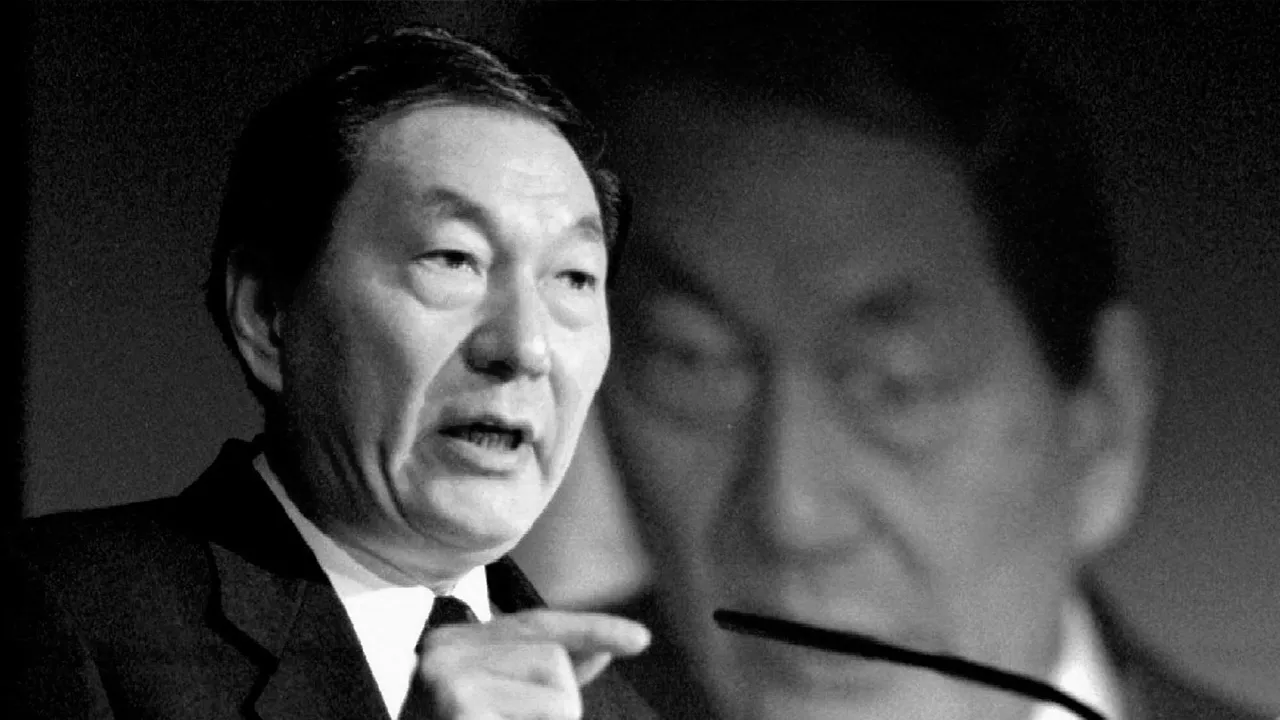
IN March 2000, a reporter asked Zhu Rongji how he hoped the Chinese people would remember him after he left office.
He did not point to a monument, a doctrine or an economic target. He said he would be satisfied if people regarded him as “a clean official, not a corrupt official” — and even more grateful if they thought he had managed to accomplish some practical things.
In that modest answer sits a demanding test of public life: power should be clean, and power should be useful.
The death of Zhu Rongji has revived memories of a Chinese premier famous for blunt speech, economic reform and impatience with corruption and bureaucratic failure. A harder-edged story, widely retold in China, has him invoking 100 coffins in his fight against corruption, including one for himself. Its lasting power lies less in the severity of the image than in the idea behind it: accountability cannot be something power demands only from others.
But Zhu’s importance cannot be reduced to personal toughness.
He served at the centre of Chinese economic policymaking during a period of difficult transition. He helped contain inflation, reshape fiscal and financial institutions, restructure state enterprises and push China through the negotiations that led to World Trade Organization membership. These reforms helped change the economic platform on which China’s later growth was built. They also imposed real costs: jobs disappeared, established interests were broken, and some arrangements created problems later governments would have to confront.
That complexity makes his record more useful, not less.
Reform is rarely a clean exchange of a bad past for a better future. It changes incentives, redistributes opportunities and produces consequences that may take years to understand. Policies that solve one generation’s problems can create another generation’s work.
The serious measure of a reformer, therefore, is not whether every decision ages perfectly. It is whether difficult problems were faced rather than concealed, whether the costs were understood, and whether the country was left with greater capacity to correct what came next.
Zhu understood another part of that obligation in four famous Chinese characters: “不做假账” — do not falsify accounts. In 2001, while addressing China’s accounting profession, he paired that instruction with a broader insistence on integrity, professional conduct and adherence to standards.
The instruction was about accounting. The principle is much larger.
Markets cannot allocate capital properly when numbers are false. Governments cannot solve problems they refuse to measure honestly. Institutions lose credibility when inconvenient facts are softened on their way upward. A country that cannot tell itself the truth eventually loses part of its ability to govern itself well.
This is where Zhu Rongji’s legacy becomes relevant far beyond China.
Malaysia has no need to import another country’s political system, or to search for a Malaysian version of a Chinese leader. Every society has its own history, institutions and political compact. What can travel across borders is not a political model, but a standard of public responsibility.
Are those entrusted with power honest about the problems before them? Are they competent enough to solve them? Can they admit when an approach is failing? Can they make difficult choices, withstand resistance and still remember whom government is ultimately meant to serve?
Fighting corruption is necessary, but it cannot be the whole national project. Corruption never disappears permanently; every generation must contain it again through institutions, enforcement and personal accountability. A clean government that cannot improve livelihoods, raise productivity or expand opportunity has completed only part of its duty.
For Malaysia, this matters in a particularly practical way.
A diverse society becomes more zero-sum when people begin to believe that the national future is fixed — that one community can advance only if another gives something up. Better government cannot erase differences of ethnicity, religion, region or politics, nor should it try. Its harder task is to enlarge the field of possibility: stronger enterprises, better wages, better education, more social mobility, more capable public services and greater confidence that effort can still improve a family’s future.
Fairness determines how a country shares what it has. Reform determines whether there will be more to share.
A larger common gain does not eliminate disagreement. It gives more people a reason to believe they can advance without somebody else having to lose.
Perhaps this is the most durable way to remember Zhu Rongji. Not as a flawless leader, and certainly not as a political model to be worshipped, but as a reminder that public office carries an obligation extending beyond the present.
Policies age. Economic models change. Even successful reforms eventually require reform of their own.
What remains is the standard.
Did those who held power leave public life more trustworthy, the country more capable, and the next generation with more possibilities than the one they inherited?
That question belongs to no ideology, party or country.
It belongs to everyone who asks to govern.
Sim Chiun Wee is the Chief Strategic Advisor on Greater China, Strategic Pan Indo-Pacific Asia (SPIPA)
** The views and opinions expressed in this article are those of the author(s) and do not necessarily reflect the position of Astro AWANI.