
AS an institution, BRICS is loose, with no permanent secretariat, and because decisions require consensus, declarations are often broadly worded. Initiatives may sound impactful and innovative but can take years to materialise.
Undoubtedly, the bloc attracts a fair amount of scepticism, some of it understandable. It might be rightly described as a “geoeconomic coalition of the willing,” but for China and India that could just be the willingness to continue as strategic rivals rather than collaborators. Iran and the UAE arrived for the BRICS Summit in New Delhi with sharply divergent positions on the Middle East conflict. Russia and China, on the other hand, are “more willing” to cast the bloc as a counterweight to Western influence. Yet India and Brazil have preferred to focus on economic cooperation and reform of existing institutions.
These limitations are real. But judging BRICS as failing to become a common market or a strategic alliance misses the point entirely. It was never designed to be either. Despite the inherent weaknesses, BRICS operates as a flexible, non-binding coalition designed to challenge Western hegemony and reform global governance.
“It’s the economy, stupid,” might well be a mere political catchphrase in an election campaign, but for Malaysia, there are practical interests at stake. That’s because BRICS brings together some of the economies that matter greatly to us. It offers another avenue for trade, finance and political dialogue, and may help Malaysia reduce its dependence on arrangements controlled elsewhere, or as Prime Minister Anwar Ibrahim put it, “to be weaned off over reliance on traditional Western markets.”
The past year has strengthened the case. Trump’s tariffs showed how a decision in Washington can affect a machinery producer in Penang or a furniture maker in Johor. War in the Middle East has raised energy and shipping costs and threatened vital sea lanes. Malaysia had little influence over either development yet must live with the consequences. No country can escape such pressures. Malaysia can, however, spread its exposure more widely by drawing on BRICS for alternative markets, financial connections and technology.
Turning economic weight into practical gains
Data compiled by the Financial Times from official and institutional sources illustrate both the scale of BRICS and how far it still needs to go. The expanded bloc accounts for roughly 40 per cent of global output at purchasing-power parity. Intra-BRICS goods exports have grown more than thirteen-fold since 2003, reaching about US$1.2 trillion in 2025. Its members include some of the world’s largest producers and consumers of energy, food, minerals and manufactured goods.
Admittedly, these figures do not prove deep economic integration, which would mandate the free movement of goods, services, and capital. Much of the trade would have happened anyway, and BRICS crucially is bereft of a common regulatory framework. Its scale, though, is undeniable. Malaysia should therefore pursue practical arrangements that widen its options and diversify its economic relationships.
Payments are a promising field. India’s Unified Payments Interface has more than 550 million users and processed US$3.4 trillion in the year to March. Brazil’s Pix has over 170 million users and handled US$6.8 trillion last year. Instant-payment systems across BRICS economies processed more than US$10 trillion in the past 18 months. In some of the bloc’s largest domestic markets, they have overtaken Mastercard and Visa.
Even so, very little of this activity crosses borders. The currencies are not always easy to exchange directly. Some are subject to capital controls. Trade imbalances create further problems. India can pay for Russian oil in rupees, but Russia has limited uses for the rupees it receives. BRICS members are now exploring how to connect these systems across borders and settle more trade in local currencies.
Malaysia already has some experience in this area. DuitNow has established links with payment systems elsewhere in Southeast Asia without requiring a monetary union. Similar links with BRICS economies could shorten settlement times and reduce conversion costs. The gains would probably be gradual, but they would not be insignificant. Bank Negara, no doubt in highly competent hands but understandably treading cautiously within a conservative paradigm, might need to explore more creative approaches to seize the moment.
The New Development Bank (NDB) deserves the same measured assessment. By the end of 2025, it had approved 139 projects worth nearly US$43 billion. Over a comparable period, the World Bank provided almost US$600 billion through its principal lending arms. Still, the NDB is hardly a replacement for the World Bank. It does, however, give developing countries another source of finance where its local-currency lending can reduce borrowers’ exposure to exchange-rate swings.
Prime Minister Anwar addressed this at the summit. No country, he argued, should have to choose between servicing its debts and meeting its obligations to its people. He called for financing better suited to development needs, pointed to the potential of Islamic capital markets and urged BRICS countries to expand technical cooperation and training in semiconductors and artificial intelligence.
Talking through differences
The Delhi summit also tested whether members could manage their political differences. In May, BRICS foreign ministers failed to agree on a joint statement after Iran and the UAE could not accept the same language on the Middle East. The dispute became public. With the war continuing, there was no guarantee the summit would turn out differently.
India nonetheless secured an agreement. After lengthy negotiations, Iran and the UAE accepted a declaration expressing deep concern over the conflict. It called for maximum restraint, the protection of civilians, respect for sovereignty and territorial integrity and the safeguarding of trade, energy flows and maritime security.
President Masoud Pezeshkian also met Abu Dhabi Crown Prince Sheikh Khaled bin Mohamed bin Zayed Al Nahyan on the sidelines, making it the highest-level contact between the two sides since the conflict began. The meeting did not settle their differences, but it preserved contact at a time of acute regional tension.
Anwar also used the summit to press Malaysia’s position on Palestine. While diplomatically avoiding the G-word, he nevertheless vehemently condemned Israel’s aggression in the Middle East and urged BRICS to speak plainly against occupation and settler terrorism. “No life weighs less for where it is lived,” he said.
Strategic autonomy in practice
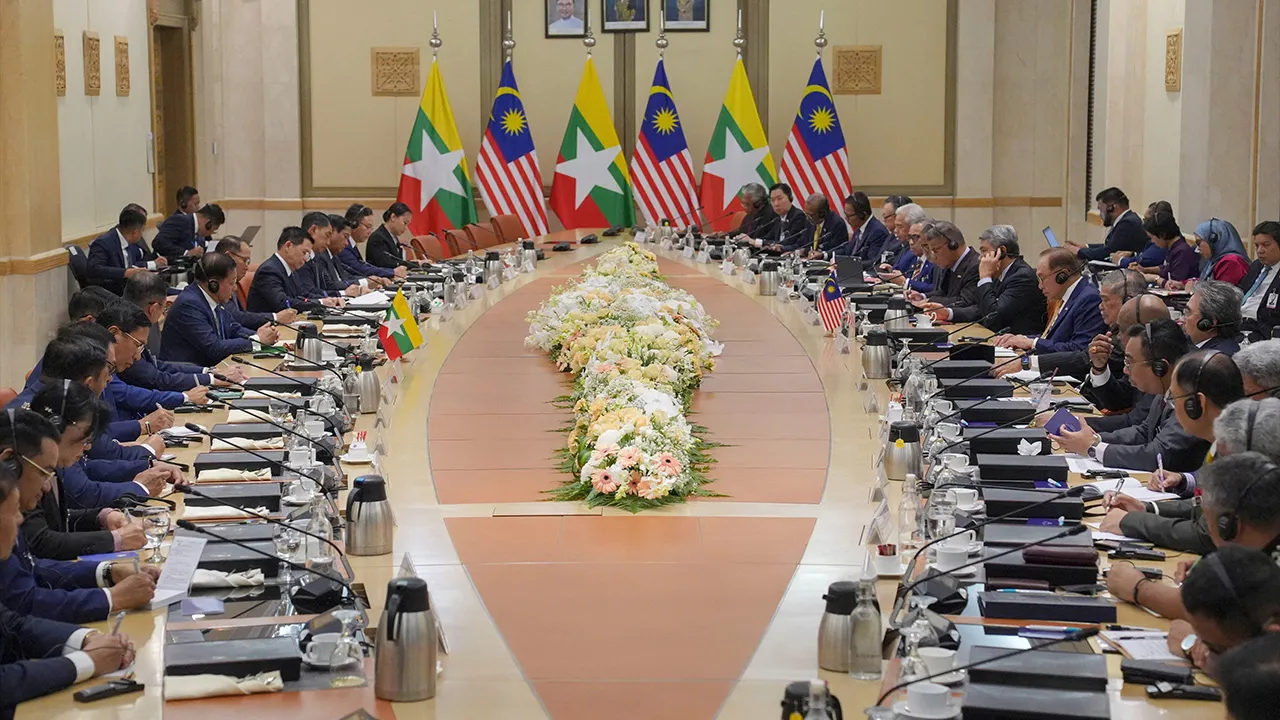
The gathering also presented Malaysia with important opportunities on the bilateral front. During his visit to New Delhi, Anwar held bilateral meetings with President Putin, President Pezeshkian, Prime Minister Modi and Ethiopian Prime Minister Abiy Ahmed.
Malaysia should not expect BRICS to replace the existing international order. The country’s trade and financial stability still rely heavily on established international institutions. Its relationships with the United States, Europe and Japan remain vital. BRICS is likely to remain most credible when it concentrates on development, finance, trade and technology. A greater role in security and defence would test its cohesion, given how differently its members approach those questions.
Malaysia’s status as a Partner Country suits this approach. It allows the government to pursue useful projects without endorsing every position taken by the bloc or its members. Malaysia remains free to cooperate elsewhere, as it must. Anwar defined strategic autonomy in New Delhi as the freedom to choose Malaysia’s own course and the courage to stand by that choice. Such freedom depends partly on having other markets, sources of finance and diplomatic channels available when established arrangements come under pressure.
For Malaysia, BRICS is one way of giving that idea practical effect.
Datuk Professor Dr Mohd Faiz Abdullah is Executive Chairman of the Institute of Strategic and International Studies, Malaysia.
** The views and opinions expressed in this article are those of the author(s) and do not necessarily reflect the position of Astro AWANI.