HAPAG-Lloyd has just put a price on a closed waterway: US$600 million in one quarter. That is what the container shipping group says the Middle East conflict and closure of the Strait of Hormuz cost it in the second quarter. The figure matters because it translates geopolitics into something every business understands. When a vital route closes, the bill appears in fuel, insurance, storage, delays and the cost of finding another way.
For Asia, Hormuz and Malacca sit within the same energy and trade system. About 21 million barrels of oil a day passed through Hormuz in the first half of 2025, with Asia receiving the overwhelming majority of its crude and condensate flows. Farther east, Malacca carried about 29 per cent of global seaborne oil flows in the first half of 2025 and nearly 22 per cent of global maritime trade. One opens the Gulf to global markets; the other lies on the shortest major sea route between East Asia and the Indian Ocean, and onward to the Middle East and Europe. Trouble at either end travels much farther than the strait itself.
Singapore shows why geography alone is never enough. In 2025 it handled a record 44.66 million TEUs, remained the world’s largest bunkering port, connected with more than 600 ports and hosted over 200 international shipping groups. Ships do not call simply because Singapore sits beside Malacca. They call because fuel, cargo, finance, insurance, ship management, technology, expertise and onward sailings are already there. During disruption, that ecosystem gives operators choices without requiring them to rebuild the network around every new shock.
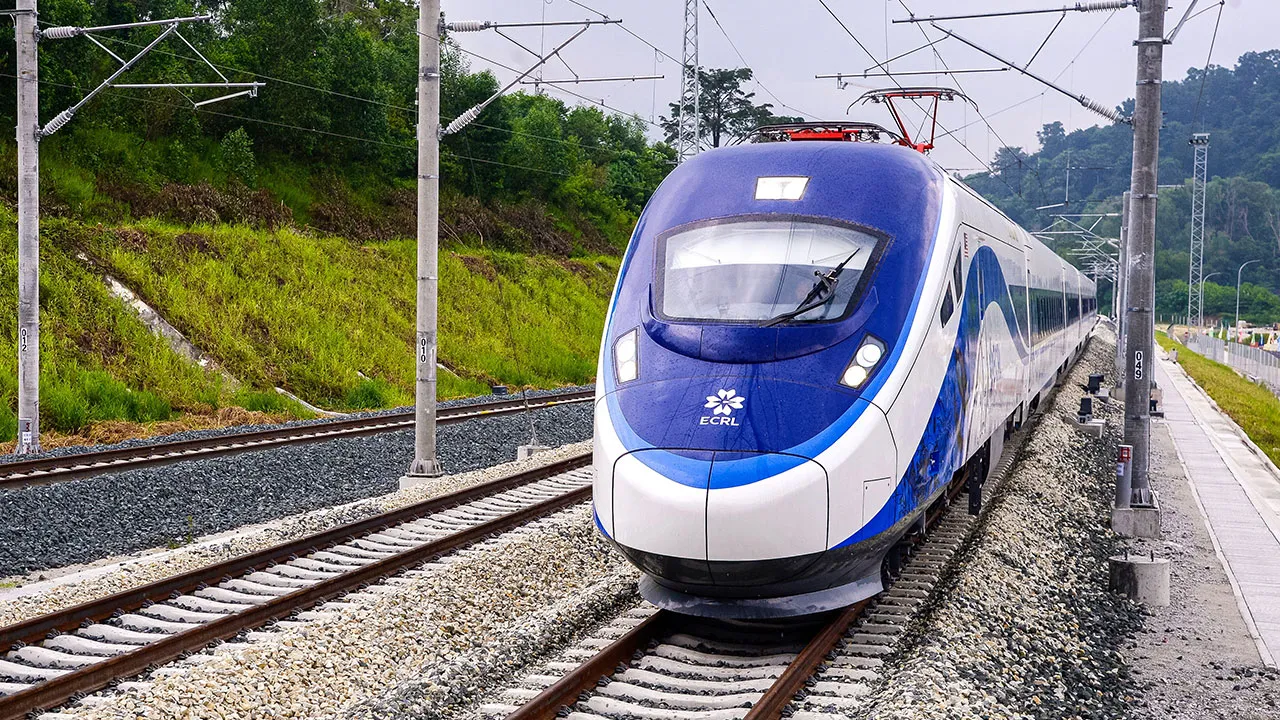
Malaysia does not need to recreate Singapore. Its geography offers a different possibility. Port Klang faces the Malacca side of the peninsula, Kuantan faces the South China Sea, and a substantial industrial base lies between them. The ECRL is intended to connect the east and west coasts, including a land-bridge concept linking Kuantan Port and Port Klang. If ports, rail and industry can operate as one corridor, Malaysia gains something more useful than another piece of infrastructure: the ability to move cargo efficiently towards either coast.
But a railway across a peninsula is not automatically a shortcut. A container leaving one ship for rail must still be unloaded, transferred, carried across the country and matched with another vessel. Freight cost, train frequency, transit time, loading charges and last-mile connections will decide whether the route works commercially. If the time saved at sea is lost waiting on land, the shorter route has achieved very little.
The stronger case for ECRL therefore begins with Malaysia itself. Official planning places industrial, commercial and logistics development at the centre of the corridor’s economic potential. In normal times, regular domestic and industrial cargo must give the railway the volume, schedules and operating discipline it needs. Under stress, selected high-value or time-sensitive cargo may find an east-west connection worthwhile. In a severe disruption, that everyday operating capability can become strategic resilience.
A second route has to acquire commercial life before it can acquire strategic value. ASEAN’s response to the Middle East crisis has stressed secure sea lanes, stronger logistics coordination and keeping ports, airports and land borders open where possible. But keeping routes open on paper is easier than switching real cargo between them. A backup port without connecting transport, or a railway without regular freight and trained operators, can exist physically and still fail when it matters.
Globalisation will continue to favour the cheapest reliable route. Hormuz does not mean companies will suddenly abandon efficient shipping. It means some will pay more for an alternative once they understand what having no alternative can cost.
That gives Malaysia a more realistic ambition. ECRL does not have to replace Singapore, and no railway can replace the Strait of Malacca. The opportunity is to make Malaysia’s two coasts, ports and industrial hinterland work together well enough that an alternative route is economically useful in ordinary times and genuinely available in extraordinary ones.
The next advantage in global trade may not belong to whoever owns the shortest route, but to whoever already has the best second route working.
Sim Chiun Wee is the Chief Strategic Advisor on Greater China, Strategic Pan Indo-Pacific Asia (SPIPA)
** The views and opinions expressed in this article are those of the author(s) and do not necessarily reflect the position of Astro AWANI.