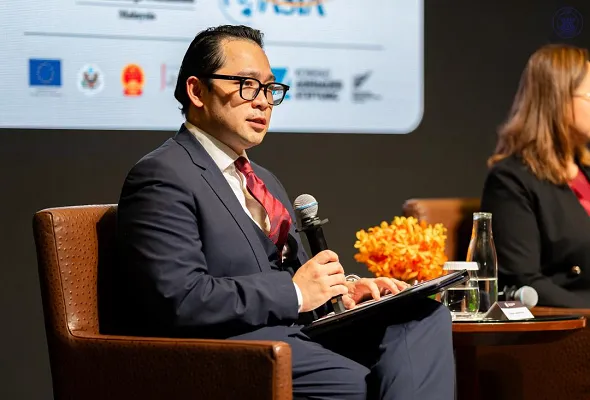
KUALA LUMPUR: ASEAN's long-term relevance depends on sustained political leadership to reform the bloc's institutions and pursue collective strategic action, according to regional security analyst Dr. Evan Laksmana.
Speaking on the sidelines of the 39th Asia-Pacific Roundtable, Laksmana, a Shangri-La Dialogue Senior Fellow at the International Institute for Strategic Studies (IISS), said ASEAN's current structures remain constrained by an unrevised ASEAN Charter and a decision-making process that relies heavily on consensus.
"The fundamental revision is the ASEAN Charter revision," he said, noting ASEAN has reviewed its institutions but never reassessed the Charter itself," said Laksmana
He said questions as to whether the ASEAN Secretary-General should be given greater authority or whether consensus should remain the bloc's only decision-making model deserve renewed consideration.
He also said the region has also focused too heavily on annual chairmanships rather than sustained leadership from member states.
"Leadership should still be visible regardless of whether that country is Chair.
His comments came as ASEAN faces mounting geopolitical challenges, including major power competition, regional conflicts and the ongoing crisis in Myanmar, all of which have tested the bloc's ability to respond collectively.
Laksmana said ASEAN is effective at convening dialogue and building regional norms but cautioned that these strengths alone are insufficient to address increasingly complex security and economic challenges.
He argued that smaller groups of ASEAN members working together, including with external partners, should complement rather than undermine ASEAN, adding that flexible "ASEAN Plus" frameworks involving dialogue partners are likely to play a growing role in responding to regional security and geopolitical challenges.
"ASEAN is neither the saviour of us all, nor the most useless thing in the region. The answer is always in the middle," he said.
Therefore, Laksmana said ASEAN should take a more active role in shaping its engagement with major powers rather than reacting to geopolitical developments, citing tensions between the United States and Iran, U.S.-China strategic competition and deteriorating China-Japan relations.
As national interests increasingly outweigh regional priorities, member states are more inclined to engage major powers individually, weakening ASEAN's collective voice.
Without greater strategic engagement, ASEAN risks remaining "a strategic spectator," reacting to crises rather than helping shape their outcomes.