This article first appeared on Aurora Insights
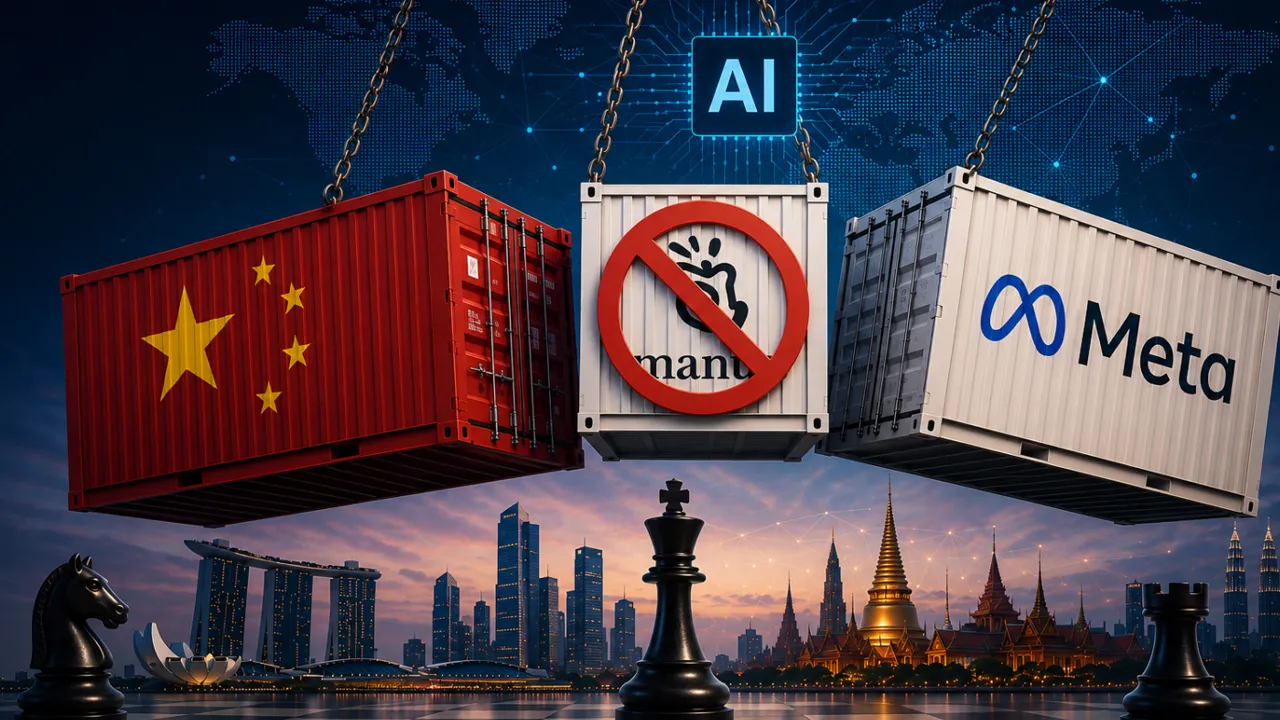
LAST month, China blocked Meta’s US$2 billion acquisition of Manus, a Chinese-founded, Singapore-based AI startup. The timing is not incidental. At the peak of US-China AI competition, breakthrough technologies are no longer just commercial assets; they are instruments of national strategy. There is no longer a purely commercial decision for tech companies in the age of cross-border AI. The new reality dictates that tech companies need to reconcile the fact that geopolitics and tech development are inextricably linked, and factor it into their strategic and operational realities.
What Does This Mean for Tech Companies in Asia?
The most important lesson from the Manus case is one that Chinese tech startups need to realize immediately: corporate registration does not determine regulatory exposure. Thus, companies’ strategic direction needs to be determined from Day 1. If a product is designed for Chinese users, built with Chinese data or developed by a team in mainland China, companies will face Chinese oversight even if they are legally registered elsewhere. If you are an AI startup with founding teams, training data, or core IP linked to China, you need to map your actual technology lineage before your next funding round. Acquirers and investors will also need to do the same diligence.
For tech companies operating more broadly across Asia, the implications are equally clear. Proactive regulatory engagement is not optional; it is the foundation of sustainable operations. This means building genuine understanding and compliance architecture around data governance, national security review and technology transfer frameworks across every jurisdiction in which a company operates. Global tech giants like Google and Microsoft, which have deepened their presence in Asia, are already actively working with regulators to develop AI testing frameworks and safety standards. Companies that treat compliance as a strategic priority rather than just a box-ticking exercise will be in a better position to navigate what comes next.
What Does This Mean for Southeast Asia?
The most significant near-term consequence for Southeast Asia is this: Chinese tech startups that had considered following Manus’s approach by re-registering in Singapore or other Southeast Asian jurisdictions to attract Western capital will now have to think twice. Chinese companies that see Southeast Asia primarily as a way to sidestep geopolitical scrutiny will find that the “Singapore-washing” model is exposed and increasingly less viable.
Yet, tighter Chinese regulation in the future will not undermine the region’s status as a destination for tech investment. For Southeast Asia’s broader investment climate, the fundamentals remain intact, as the region continues to offer strong infrastructure, international connectivity and a stable business environment. The region’s overall appeal to global tech remains undiminished.
The deeper question, regards Southeast Asia’s own positioning. The region sits at the intersection of US-China competition, and Southeast Asian leaders will increasingly face pressure to take positions on how cross-border technology investment is governed. Southeast Asian regulators that do not develop clearer frameworks for evaluating technology transfers and data flows risk becoming reactive and responding to individual cases rather than shaping the rules so that they can best compete and grow. The Manus case is a reminder that jurisdictions that move first to establish clear, credible governance standards for AI investments will attract the capital and the talent that others will lose through ambiguity.
What Does This Signify for Global AI Development?
The Manus case reflects the accelerating securitization of AI. Countries are increasingly treating AI as a strategic asset tied to national security, economic competitiveness and geopolitical influence. Two developments are already in motion.
- First, regulations around technology transfers, data governance and cross border AI acquisitions will become tighter and more clearly defined. Gone are the eras of ambiguous rules or gray areas.
Second, cooperation on global AI development will become more selective across geopolitical divides. Collaboration on safety standards or shared research would still be possible, but collaboration on core capability is becoming structurally more challenging.
What this means in practice: the compliance burden for cross-border AI will grow, and strategic collaboration will require more deliberate partner selection across geopolitical lines. But there is also an opportunity in this shift – when AI becomes a national asset, tech companies that align with their home country’s strategic direction gain access to state resources, policy support, and a clearer lane to compete globally.
Conclusion
The Manus case is a preview, not an outlier. What it reveals is this: AI is now a geopolitical asset, and the rules governing how it is built, owned, and transferred across borders are being rewritten in real time – faster than most businesses are moving.
Companies that treat it as a one-off miss the pattern. The securitisation of AI is structural, and it is accelerating. For tech companies in Asia, for Southeast Asian regulators, and for anyone operating in the cross-border AI space, the regulatory, investment, and competitive environment will not revert to what it was.
The implications run across every layer of a business. Corporate structure, technology lineage, data governance, and regulatory relationships are no longer back-office considerations. They are strategic ones. Businesses that don’t adapt will find out the hard way.
Key Takeaways for Businesses
1. Stay ahead of geopolitical and policy risk. The businesses caught off guard are the ones that treated regulatory monitoring as a compliance function rather than a strategic one. Build it into your decision-making early, not after the deal is blocked.
2. Treat compliance as strategy, not administration. Proactive engagement with regulators across every jurisdiction you operate in is no longer optional. Early and stronger engagement helps businesses anticipate policy shifts and reduce regulatory friction.
3. Choose your markets and partners with geopolitics in mind. Who you build with, where your data flows, and which markets you serve are decisions that carry regulatory and strategic weight. Make them deliberately.
Aurora Insights is a corporate geopolitical advisory firm specialising in energy, AI and critical minerals sectors. They help businesses navigate complex geopolitical landscapes to identify and assess operational risks & explore new market opportunities.