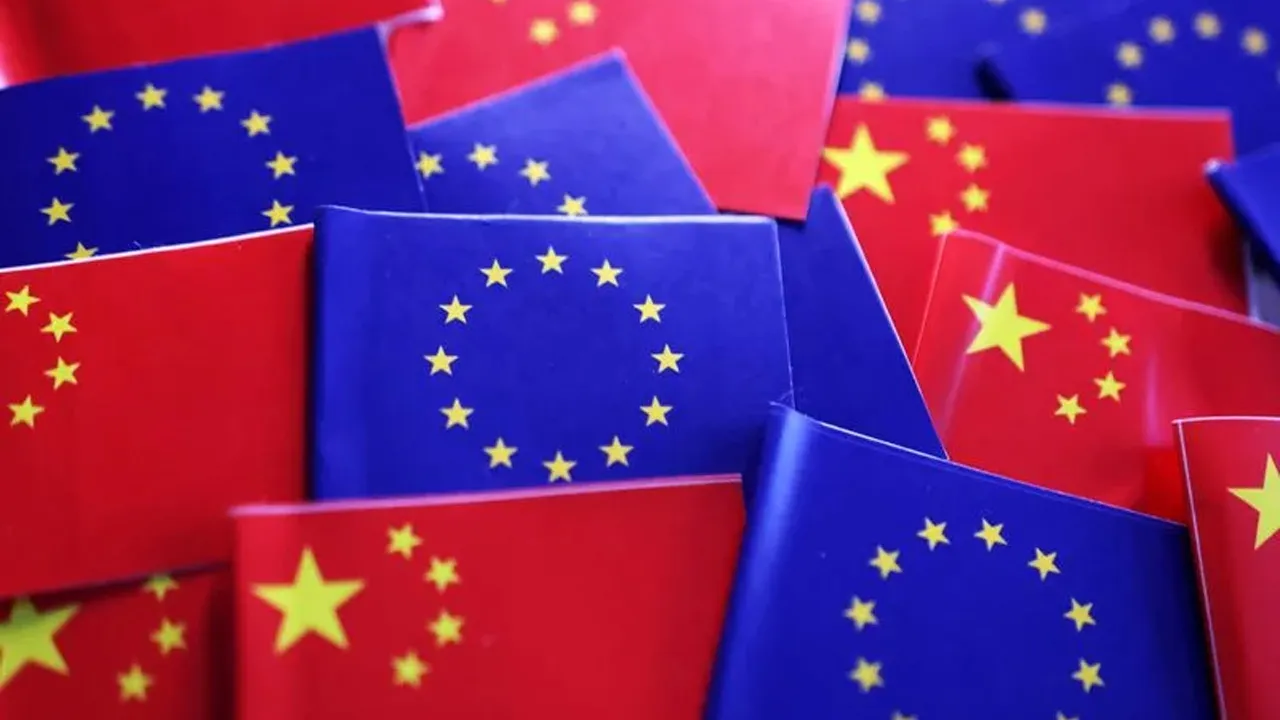

Today, the People's Republic of China marks its 77th anniversary on October 1.
For much of those 77 years, the outside world asked a familiar question: Can China catch up?
That question now feels incomplete.
A more useful one is this:
How much of the future can be built without taking China into account?
China's trajectory is familiar. The People's Republic was founded in 1949. Reform and opening began in 1978. In 2001, China joined the WTO. Two years later, it sent its first astronaut into space. Then came Beijing in 2008.
The world came to watch an Olympic Games.
It ended up watching a country.
That night made one thing unusually visible:
Scale is not capability. Making scale work is.
The world had invested in China. China manufactured for the world. Then Chinese capital, companies, technology and industrial capabilities began moving outward.
Now the boundaries are harder to draw.
A European brand can use Chinese technology, manufacture in ASEAN with local workers, raise global capital and sell into markets everywhere. A battery assembled in Southeast Asia may depend on materials processed in China, equipment from several countries and customers on another continent.
None of this is uniquely Chinese. Global companies have worked across borders for decades.
What is unusual is the speed and scale with which one of globalisation's greatest recipients has also become one of its major contributors.
China is no longer simply going global. China and the world are becoming embedded in each other.
The International Energy Agency says China accounts for 60% to 85% of production capacity across key clean-energy supply chains, and more than 95% in some individual production steps.
ASEAN offers an even closer view. ASEAN's preliminary statistics put two-way merchandise trade with China at US$913 billion in 2025, up 18.2%. China remained ASEAN's largest trading partner and its third-largest source of foreign direct investment.
In September, Reuters reported that ASEAN economies had already spent more than US$20 billion on Chinese-made clean-tech products in 2026, making Southeast Asia the largest market in Asia for those exports.
The upgraded ASEAN-China Free Trade Area 3.0 also reaches beyond traditional tariffs into areas including the digital economy, green economy and supply-chain connectivity.
This is no longer simply a story of one country exporting more goods.
It is a story of production systems becoming entangled.
And that creates one of the defining contradictions of our time.
Governments increasingly speak about de-risking, strategic autonomy and supply-chain security. Concentration creates vulnerability; overdependence on any one country, supplier or route can become a risk.
Yet the deeper governments and companies look into batteries, energy technology, manufacturing, logistics, critical materials and industrial equipment, the harder it becomes to draw a clean line around where China ends and the rest of the world begins.
This may be China's harder-to-copy advantage.
Not any single factory, car, battery, port or technology.
The advantage is the density around them: suppliers near manufacturers, infrastructure near industry, energy near demand, engineers near production, and markets connected to all of them.
A product can be copied.
An ecosystem that allows thousands of things to work together is much harder to reproduce.
But that brings China to a different test.
For much of the past 77 years, China had to prove that it could build strength.
The next test is whether that strength can also build trust.
China's modern history includes wars, foreign incursions and the "unequal treaties" that granted foreign powers privileged status and extracted concessions. That history makes one principle particularly relevant: sovereignty and room to choose matter to other countries too.
A stronger China will ultimately be judged not only by what it builds abroad, but by what remains with its partners after the building is done:
more capability or more dependency;
more room to choose or less.
That is where durable confidence will come from.
Not from asking countries to believe there is no risk.
Not from making them dependent.
But from giving countries with alternatives good reasons to continue choosing China.
Because the strongest proof of influence is not that others have no choice but to need you.
It is that, when they have choices, they still choose to work with you.
Seventy-seven years ago, China was searching for its place in the world.
Today, while the world is still debating how to understand China, China is already woven into how much of that world manufactures, moves, powers, trades and innovates.
So the next chapter should not be measured simply by how many more world firsts China produces.
The harder measure is this:
Can China's growing strength expand the choices of the countries around it, rather than narrow them?
If it can, that may prove more consequential than any ranking, megaproject or technological milestone.
It would mark something larger:
the point at which China's rise became not only a fact of Chinese history, but a source of confidence beyond China itself.
CW Sim is Chief Strategic Advisor on Greater China, Strategic Pan Indo-Pacific Asia (SPIPA)
** The views and opinions expressed in this article are those of the author(s) and do not necessarily reflect the position of Astro AWANI.