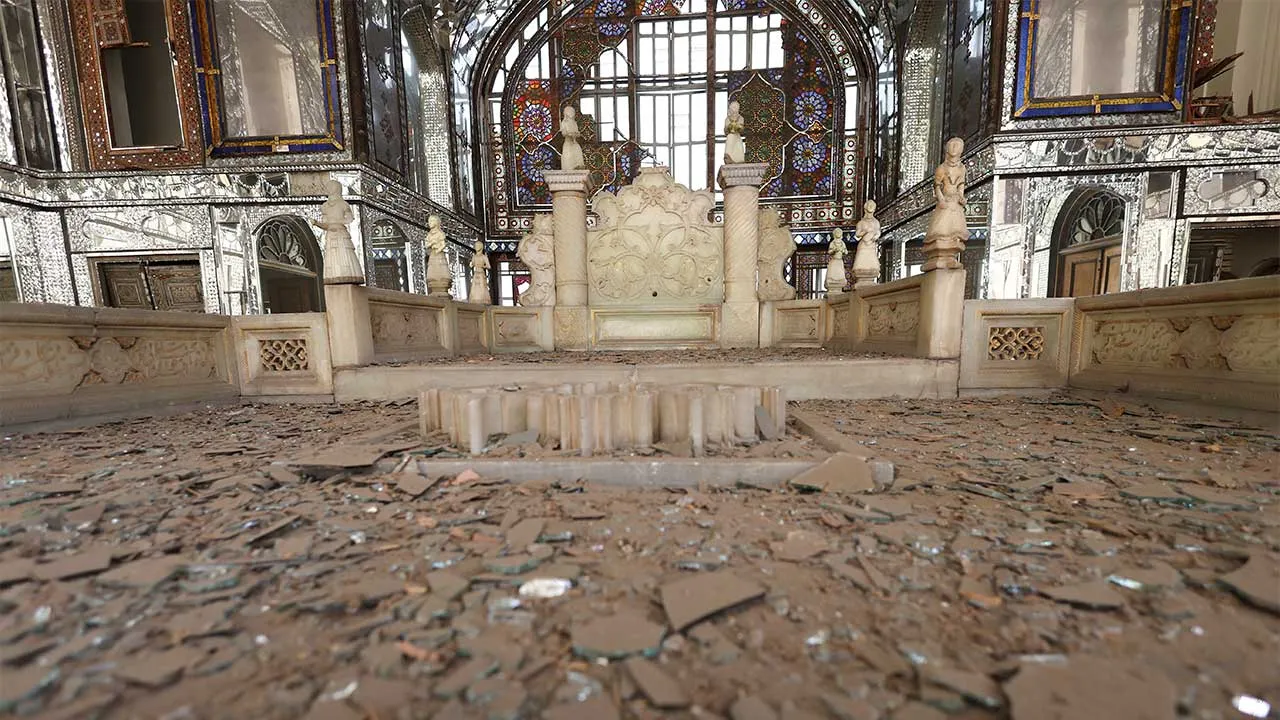
A first set of blast waves set ancient domes and minarets trembling around the most famous square in the ancient city of Isfahan. Another bombing in the city center, two days later, blanketed the floors of a 400-year-old royal complex with shards of debris.
Those Israeli airstrikes, on March 7 and 9, shook the monuments at Naqsh-e Jahan square and the Chehel Sotoun Palace, two of Iran's most treasured cultural complexes.
In March, before the cease-fire in the U.S.-Israel war on Iran, Reuters journalists were granted rare access to the palace and Naqsh-e Jahan square and its surroundings, as well as two palaces in Tehran. They saw firsthand how the war has damaged Iran's historic sites, including some protected under an international treaty administered by the U.N. cultural body UNESCO. In all, Reuters journalists observed damage at 11 historic buildings.
Experts who track the war's impact on world heritage sites confirmed damage at the Jameh Mosque in Isfahan, the Trans-Iranian Railway, and an 1,800-year-old fortress near prehistoric caves settled by humans as long as 63,000 years ago.
In two decades of ground and air warfare by the United States and its allies in Iraq, Syria, Libya and Afghanistan, Reuters could find no examples of damage to cultural heritage sites listed at the time by UNESCO.
UNESCO hasn’t yet sent teams to the sites protected in its register and has been limited to using satellite imagery to assess the damage. To date, UNESCO says it has verified damage at seven sites in Iran, including two on its international list as well as four cultural properties of national importance and a religious site.
UNESCO told Reuters it was not consulted either before or during the war but shared coordinates of critical sites with "all parties in the conflict."
Ranging from shattered glass and broken tile to cracked walls and shaken foundations, the damage was mostly inflicted by bomb shock waves radiating out nearly 20 times faster than the speed of sound. Those blast waves can cause severe damage to structures nearly a kilometer away from the detonation itself, according to Wes Bryant, a former targeting specialist with the U.S. Air Force.
The Israel Defense Forces acknowledged targeting the governor's office in Isfahan, which is adjacent to the UNESCO-listed palace complex, and a base belonging to the Islamic Revolutionary Guard Corps about a kilometer from the historic sites. "The IDF operates in accordance with international law and targets military objectives only," an IDF statement said.
Reuters spoke to eight experts in Middle Eastern archaeology and preservation of heritage sites who said the reporting shows a clear shift in U.S. targeting practices and priorities away from protecting internationally recognized historical landmarks. The shift comes two decades after widespread criticism of an American military base set up in the ruins of the ancient city of Babylon and the looting of the Baghdad Museum prompted the Pentagon to revamp its policies on protection of cultural sites.
In recent wars, Bryant said, historical landmarks would have been included on "no strike lists." Dropping bombs on or near these sites required both a compelling military necessity and high-level approval, sometimes even from the White House.
Among the sites damaged were Tehran's Golestan Palace and bazaar; four sites at Isfahan's Naqsh-e Jahan Square; and the Chehel Sotoun complex. Experts also confirmed damage at Jameh Mosque in Isfahan, the Andimeshk railway station along the UNESCO-listed Trans-Iranian Railway, and Falak-ol-Aflak, an ancient fortress in western Iran's Khorramabad Valley.
Iran's UNESCO representative provided a list of 134 cultural heritage sites it said were damaged by the war.
The 1954 Hague Convention explicitly protects sites like those in Isfahan during armed conflict. The intentional targeting of civilian cultural property is considered a war crime under international law, and any strikes on nearby targets must be carefully weighed against any damage they might sustain.
The Pentagon declined to comment. "Operation Epic Fury was scoped around key objectives: destroy Iran's ballistic missiles, demolish their production facilities, sink their navy, weaken their proxies, and ensure they can never possess a nuclear weapon," said Anna Kelly, a White House spokeswoman.
At Ali Qapu Palace, pictures taken by heritage officials and by Reuters showed a crumbled wall, cracks on the body of the building, and shattered glass. The initial Iranian assessment said more than 70% of the glass in windows and doors was broken. Employees at the Shah Mosque brought in a sack filled with pieces of blue tiles that had fallen off.
In Tehran, on the night of March 1, American and Israeli forces struck the city's judicial buildings adjacent to the ancient Golestan Palace, which became a sea of debris, with shattered wooden artwork and mirrors knocked down from the ceiling. UNESCO, which lists the palace as a world heritage site, has expressed "concerns" over the site's damage.