
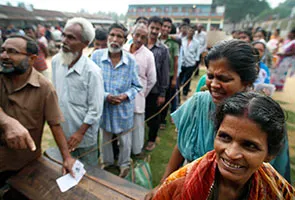
Retired tea worker Vilati Tati has a strong brew of complaints about the Congress government and queuing at the start of India's election required a Herculean effort for the 70-year-old.
But after a lifetime working on plantations in India's famed northeastern Assam tea district, Tati said she had no qualms about still voting for the ruling party even though it faces electoral humiliation elsewhere.
"I voted for the hand," she said of the political symbol of India's historic party of government which is still dominant in Assam.
"Garden workers have always voted for Congress."
Tati's list of complaints is one that can be heard throughout much of India, including the lack of any retirement or medical benefits after almost 50 years of often back-breaking work.
The only savings she has are the 70,000 rupees ($1,200) she put aside while working.
Rabin Bhumij, a supervisor at the 745-hectare Bokel plantation near the city of Dibrugarh, also struggles to make ends meet with a salary of just 5,000 rupees a month ($83) which is supplemented by rations of wheat, rice and firewood.
"Our salaries continue to be low, we do not get enough rations and our electricity bill is too high," Bhumij told AFP when asked about his biggest problems.
Yet despite all this, he will vote again for local MP Paban Singh Ghatowar, who is a low-profile government minister for development in India's northeast.
"Nothing has changed during Ghatowar's five terms here," said Bhumij.
But the politician is also crucially a former union leader for tea workers and thus Bhumij will stick with one of his own.
"We are proud that one of us has made it to the parliament," he added.
And with tea workers representing more than a quarter of the 1.1 million-strong electorate of Dibrugarh, this support, however begrudgingly offered, is a huge advantage for Ghatowar as he seeks a sixth term.
Blind loyalty
It illustrates one of Indian democracy's enduring features: that loyalty to one's own tribe or community often trumps all other considerations, even when a law-maker is considered inept.
Speaking to AFP, Ghatowar insisted that the tea workers of Assam fared better than those in other parts of the country, including in neighbouring West Bengal, which is home to the famed Darjeeling region.
"Every industry has its own grievances. If we compare the tea plantation workers in Assam and West Bengal, the Assam tea workers are much better off," he said.
Ghatowar said that he would "focus on industrialisation in this constituency" if he wins an expected sixth term -- albeit most likely in opposition to the Hindu nationalist Bharatiya Janata Party.
Three generations of tea estate manager Bhumij's family have worked on the same plantation in Assam, while he himself has been employed here for 35 years.
Bhumij is part of a community of tea workers whose ancestors were transported from mainly tribal areas of central India by the British to work on tea plantations as indentured labour.
He lives with his family of nine people, including three grandchildren in a bamboo shack. His children dropped out of school as he could not provide for their education.
A vestige of British-ruled India, the plantations can pay as little as 95 rupees ($1.58) a day to their staff.