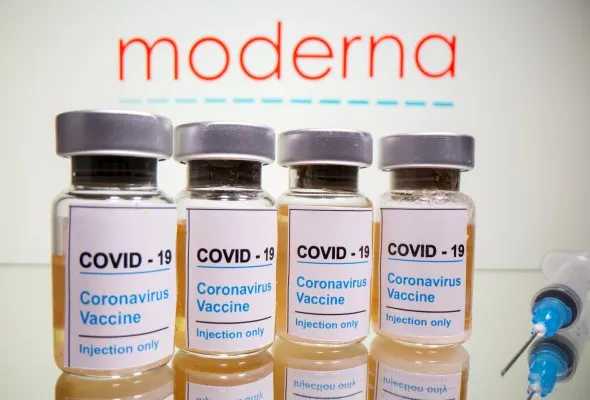
U.S drugmaker Moderna announced on Monday that it's coronavirus vaccine is 94.5 percent effective, joining Pfizer in reporting encouraging trial results on a COVID-19 vaccine. Pfizer has said its vaccine is also more than 90% effective.
WHAT DID MODERNA ANNOUNCE?
HOW DOES THE VACCINE WORK?
HOW IS MODERNA'S COVID-19 VACCINE DIFFERENT FROM PFIZER’S?
THE COST OF VACCINE
WHAT IS NEXT?
WHAT DID MODERNA ANNOUNCE?
- Early results from Phase 3 clinical trials of it's experimental COVID-19 vaccine have shown an efficacy of 94.5 percent.
- The trial involved more than 30,000 participants in the U.S. split into two groups. One group given two doses of the vaccine, four weeks apart and the other group given a placebo.
- The results also suggest the vaccine is effective in older people and those from diverse ethnic backgrounds.
- The inclusion of high-risk and elderly people in the Moderna trial suggested the vaccine would protect those most vulnerable to the disease
- However, the new findings have not yet been peer-reviewed.
- The trial is not yet complete and it is not clear how long any protection may last.
HOW DOES THE VACCINE WORK?
- Moderna vaccine is based on introducing genetic material, known as Messenger RNA or mRNA.
- The surface of the SARS-CoV-2 virus is covered in protein spikes.
- When Moderna’s mRNA vaccine is introduced to the body, it would teach the body to recognize these spikes, allowing the body to produce neutralizing antibodies to stop the coronavirus before it can establish an infection.
HOW IS MODERNA'S COVID-19 VACCINE DIFFERENT FROM PFIZER’S?
- Both vaccines are based on the same approach - introducing part of the virus' genetic code into the body, in order to trigger an immune response.
- What's interesting is that Moderna said that its vaccine can be stored at normal fridge temperatures of 2 to 8 degrees Celcius for 30 days.
- Pfizer, on the other hand, said it's vaccine needs ultra-cold storage at around - 70 degrees Celcius, but it can be kept in the fridge for five days. The need for Pfizer's vaccine to be stored and shipped at ultra-cool temperatures might complicate distribution.
THE COST OF VACCINE
- Moderna said its vaccine is more expensive than the other frontrunners. It would charge at about US$24.80 per dose to the U.S government, and about US$32 - US$37 per dose to other governments.
- AstraZeneca and Oxford University are aiming to sell their vaccine at about US$3.95 a dose.
- Vaccines in trial with Johnson and Johnson and a collaboration between Sanofi and GSK are both expected to cost about US$10.50 per dose.
- Pfizer is charging the US about US$39 for a two-shot course.
WHAT IS NEXT?
- The company said it now plans to apply to the US regulator, the Food and Drug Administration, for emergency-use authorisation in the coming weeks
- It expects to have 20 million doses available in the US.
- Moderna said it is on track to produce 20 million doses of the vaccine by the end of the year.
- The company is also working with the Swiss company Lonza and Laboratorios Farmacéuticos Rovi of Spain to make doses of the vaccine outside the United States.
- The company hopes to have up to one billion doses available for use around the world next year and is planning to seek approval in other countries too.