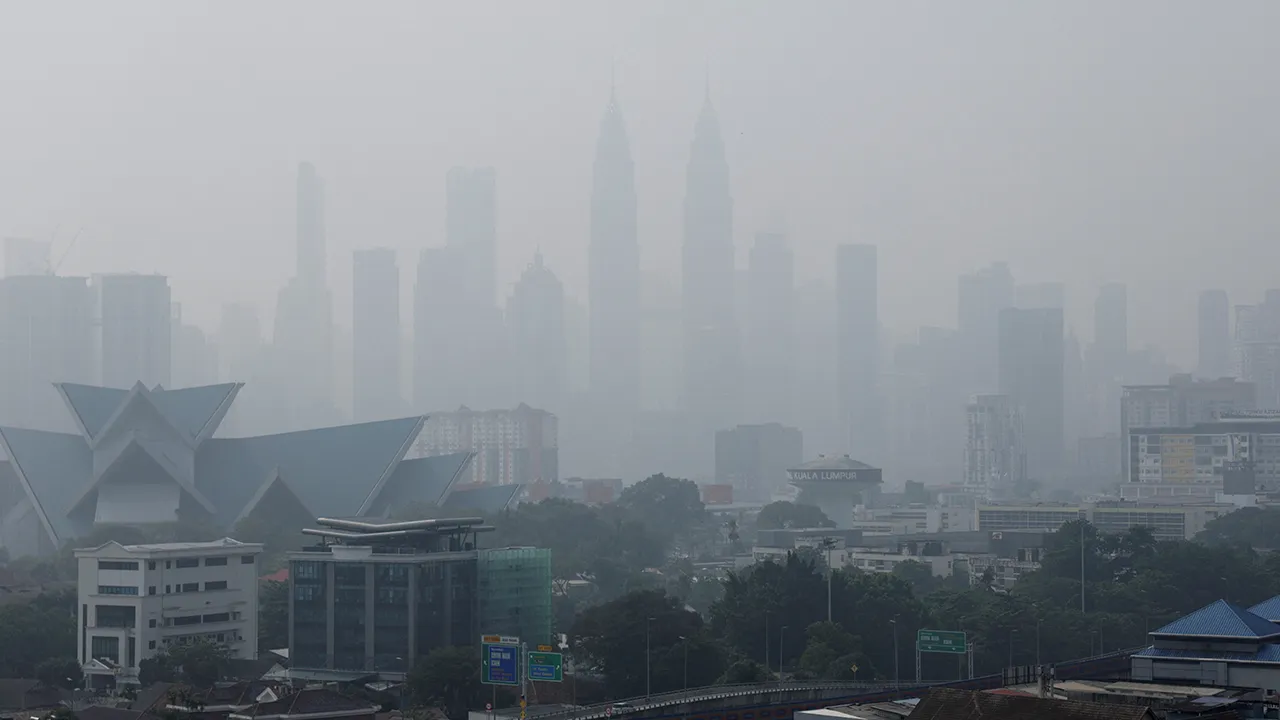
ON 14 November, the ASEAN Secretariat received Malaysia's instrument of ratification for the agreement to establish a regional centre for transboundary haze pollution control.
In October, Astro AWANI's Dialog Tiga Penjuru asked who bears the cost of recurring haze. Malaysia's ratification raises a practical follow-up.
What can government agencies do before the next episode, while there is still time to agree on how to share evidence, issue warnings and respond to fires?
What the centre will do
The centre will be based in Indonesia. Its role is to gather and analyse data on fires and haze from each country, and to help countries coordinate their response, including requests for help.
The agreement takes effect 60 days after the sixth instrument of ratification, acceptance, approval or accession is deposited with the ASEAN Secretary-General.
As at 21 November, ASEAN's register listed three deposits, from Viet Nam, Singapore and Malaysia. The agreement is therefore not yet in force.
The centre does not replace national authorities. Under the 2002 ASEAN haze agreement, the national authority acts first to put out the fires. When it declares an emergency, it may ask the centre for help.
That cooperation matters. If an alert reaches the right people early, help can be offered while a fire is still easier to contain.
Shared information can also help authorities explain to the public where the smoke is likely coming from, and how certain they are. Prosecution and claims for compensation would still have to proceed under the applicable law.
Consider what an agency in Malaysia needs when smoke begins to cross the border. It needs to know which agency can confirm whether a detected hotspot is an active fire, when the information was last checked, and who can supply an update.
The centre could help countries agree on a common format for these reports, and a point of contact in each country. Such arrangements are best tested in a joint exercise, before they are needed.
Who can be held responsible?
Malaysia's Environmental Quality Act 1974 generally prohibits open burning, subject to exclusions by ministerial order. When the fires start overseas, investigators may need documents and witnesses in another country.
In October, the Deputy Minister of Natural Resources and Environmental Sustainability told the Dewan Rakyat that investigators would need evidence of where the fire occurred, who owned the land, who was carrying out activities there, and how the fire was linked to the haze.
Different records can help answer those questions. A land register may identify the owner. The concession map and operating records may show who managed the site when the fire broke out.
Wind data can help trace the smoke, and a report from officers on the ground can help confirm what was burning and when. Investigators need to bring these together before drawing any conclusion on responsibility.
Singapore's experience is instructive. On 4 November, its Parliament passed amendments to strengthen investigation and enforcement under its transboundary haze law.
During that debate, Singapore's environment minister told Parliament that obtaining reliable evidence was one of the main challenges in enforcing the law. She said four investigations arising from the 2015 haze were still open.
In September, Malaysia's Ministry of Natural Resources and Environmental Sustainability said it was studying Singapore's approach with a view to drafting a specific Act. Singapore's experience shows that such a law also depends on cooperation from abroad to obtain evidence.
What Malaysia can do now
Malaysia will host and chair the 28th meeting of the subregional ministerial steering committee on haze in 2027. The Minister has said Malaysia will use that role to improve data sharing and cooperation on enforcement.
In practice, that could mean agreeing who shares fire locations, land records and other evidence, and how quickly requests are answered. An agreed process gives investigators a better chance of securing records while the evidence is still available.
There is work at home, too. During the October haze, the Education Ministry gave its schools and institutions clear triggers. From 9 October, they were to close where the Air Pollutant Index passed 180, and from 12 October where it stayed above 150 for three consecutive days.
Clear triggers like these help head teachers and parents plan. The same air-quality bulletin could tell families where to check school arrangements, and when the next decision will be made.
Employers with outdoor workers face similar decisions. A contractor could identify which jobs can be moved indoors or rescheduled, and tell staff early who makes that call.
When an alert is issued, it also helps the public to know when the next update will come, and where to find it.
When the next haze arrives, a head teacher should already know whom to call. An outdoor worker should already know what happens to tomorrow's shift.
And an investigator should know whom to ask for the records that may establish who was responsible for the fire. Malaysia can make progress on all three before then.
Adj Prof JJ Chan is Managing Partner of CBE (Chan Ban Eng & Co), a Barrister-at-Law of the Honourable Society of Gray's Inn, London, an Advocate & Solicitor of the High Court of Malaya, Alumni Ambassador (Malaysia) for City St George's, University of London, Adjunct Professor at the Faculty of Law, Universiti Malaya and Founder of the Financial Lines Forum.
He specialises in financial lines, medical negligence, corporate and directors' liability, insurance/reinsurance, and AI governance risk. He also writes regularly on constitutional and public-interest matters.