AI Brief
- Pakistani astronaut Muhammad Zeeshan Ali became the first foreign astronaut to board China's Tiangong space station, marking a milestone in China-Pakistan space cooperation.
- China's lunar missions, including Chang'e-7 and Chang'e-8, will carry international scientific instruments and involve participation from over 17 countries and organizations.
- Scientists from France, Germany, Japan, Pakistan, Britain, and the United States have been granted access to lunar samples from China's Chang'e-5 mission for research.
BEIJING: From welcoming foreign astronauts aboard its space station to sharing lunar samples with scientists worldwide and providing satellite services across borders, China is steadily expanding international cooperation in space.
As its space program advances, China is making international collaboration an increasingly integral part of its efforts, creating more opportunities for countries to participate in space missions, share scientific resources and benefit from the peaceful use of space.
CREWED SPACEFLIGHT
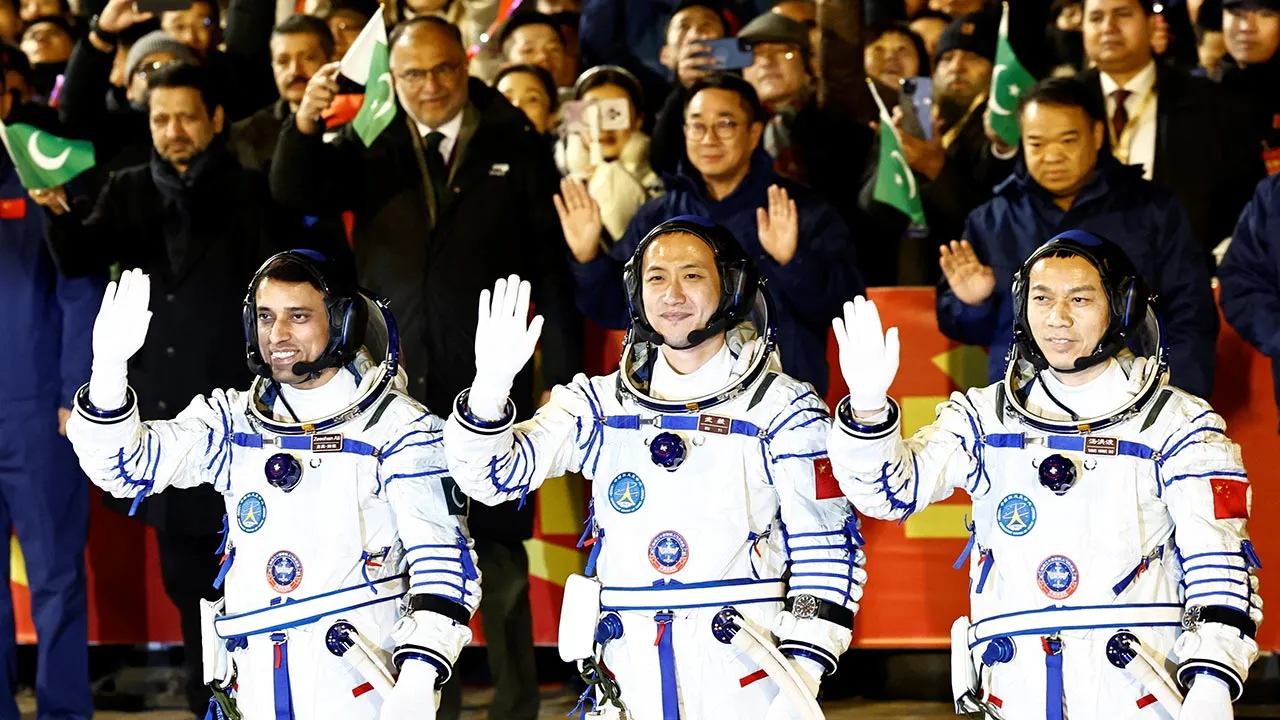
On Wednesday (November 25), Pakistani astronaut Muhammad Zeeshan Ali joined Chinese astronauts Tang Hongbo and Wu Yi aboard the Shenzhou-24 spacecraft, which lifted off from the Jiuquan Satellite Launch Center in northwest China's Gobi Desert.
The spacecraft docked with the Tiangong space station at 11:56 a.m. Beijing time (0356 GMT) on Wednesday, according to the China Manned Space Agency (CMSA). Ali thus became the first foreign astronaut to board the Chinese space station and the first Pakistani to travel into space.
His participation in the mission followed an agreement on astronaut selection and training signed by China and Pakistan in February 2025, marking a new stage in bilateral space cooperation that has evolved from satellite development to crewed spaceflight.
According to a CMSA spokesperson, four China-Pakistan cooperative projects in biotechnology and materials will be carried out during the mission. Ali will also conduct an in-orbit experiment involving photosynthetic cyanobacteria.
On the significance of the mission, Ali said, "Now it is time to show this great achievement in orbit and send the world a message that we work hand in hand for the peaceful utilization of space."
Pakistani President Asif Ali Zardari said the historic cooperation demonstrated China's remarkable progress in space science and technology, its firm commitment to the peaceful use of outer space, and the significance of building a community with a shared future for humanity.
LUNAR EXPLORATION
International cooperation in China's space program extends beyond crewed missions to lunar exploration, where foreign partners are increasingly involved in both scientific missions and research.
Chang'e-4 and Chang'e-6 each carried four international payloads. The Chang'e-7 mission is set to carry six international scientific instruments developed by six countries and one international organization, while Chang'e-8 is expected to carry payloads involving 11 countries and regions and one international organization.
The two missions will also contribute to the development of the International Lunar Research Station, a scientific facility planned to include installations on the lunar surface, in lunar orbit and on Earth. So far, 17 countries and international organizations, along with more than 50 international research institutions, have joined the project.
Cooperation also extends to the sharing of scientific resources. In April 2025, the China National Space Administration (CNSA) announced that scientists from institutions in France, Germany, Japan, Pakistan, Britain and the United States had been granted access to lunar samples brought back by the Chang'e-5 mission in 2020 for research.
The opportunity has been welcomed by researchers involved in the program. Frederic Moynier, a cosmochemist at the Paris Institute of Planetary Physics, told the Science magazine that "China is setting a very positive example for scientific cooperation."
British planetary scientist Mahesh Anand of the Open University described the opportunity as "a great honour and privilege." He said he looked forward to studying the lunar material and "building new international collaborations and partnerships."
China's lunar exploration program has consistently upheld the principles of equality, mutual benefit, peaceful utilization and win-win cooperation, the CNSA said, adding that it will continue to accept international applications for lunar sample research in the hope that scientists worldwide will make discoveries that advance human knowledge and benefit humanity.