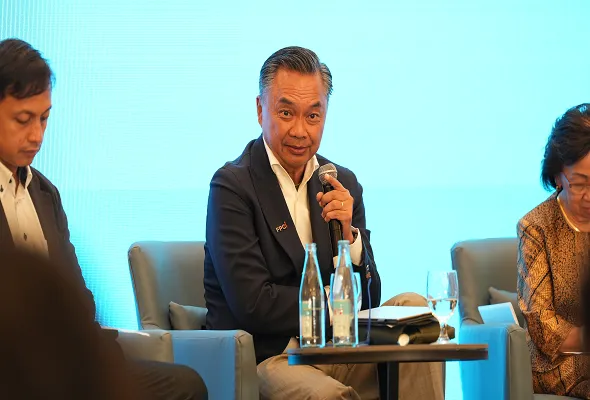
CEBU: Southeast Asian regional cooperation remains relevant despite mounting geopolitical and economic pressures, but the bloc faces persistent challenges in implementation, funding and public engagement, according to Indonesian foreign policy figure Dino Patti Djalal following the 48th ASEAN Summit in Cebu recently.
Speaking to regional journalists after summit discussions, Dino, founder of the Foreign Policy Community of Indonesia said the regional grouping continues to play a stabilising role at a time of global uncertainty, even as internal weaknesses limit its effectiveness.
“ASEAN is imperfect, but relative to other regions, ASEAN is actually in a good place,” Dino said, pointing to the bloc’s ability to keep member states engaged through dialogue despite crises.
He said ASEAN’s enduring strength lies in maintaining diplomatic channels among countries with diverse political systems and national interests.
“ASEAN’s biggest strength is that countries still sit down and talk,” he said.
The remarks come as ASEAN faces growing scrutiny over its response to regional crises, including Myanmar’s prolonged conflict, maritime tensions in the South China Sea, and rising energy security concerns.
Dino said energy security appeared to have moved to the top of ASEAN’s agenda in a way he had not seen previously, reflecting concerns over supply disruptions and wider economic vulnerability.
“I think this is the first time that energy has become at the top of agenda for ASEAN. I’ve never seen this before. And it’s important, not just for economic health, but for the political and social world,” he said.
Yet he cautioned that regional cooperation on energy remains difficult because governments tend to prioritise domestic interests.
“Energy security is probably ASEAN’s most difficult challenge because countries will always look at it from their own national security perspective,” he said.
He also questioned ASEAN’s ability to translate commitments into collective action, citing recurring implementation gaps.
“Once you have a project, can you actually run it together and implement it?” Dino said, adding that ASEAN has often struggled to sustain common projects in which all members contribute resources and participate meaningfully.
On financing, Dino said ASEAN risks underinvesting in its own institutions.
“ASEAN is 600 million people, a multi-trillion-dollar economy, and yet member states contribute around two million dollars each to the Secretariat. That is really not much,” he said.
The comments were made during the “ASEAN for the People’s Week” convened by FPCI alongside the 48th ASEAN Summit in Cebu, Philippines, from May 6 to 8, which brought together Track 1.5 analysts, diplomats, civil society actors and journalists from across the region to discuss ASEAN’s future and regional challenges.
He added that ASEAN’s long-term relevance would depend on whether it becomes more people-centred.
“ASEAN cannot be formed by governments alone,” Dino said, adding that a people-centred ASEAN has to be built by the people.