AI Brief
- Gibran Rakabuming Raka resigned as vice president following legal disputes over his educational credentials and mounting parliamentary pressure, exposing weaknesses in Indonesia’s political arrangements.
- The Constitutional and Supreme Courts questioned the validity of Gibran’s candidacy documents, highlighting institutional failures and raising concerns about the independence of electoral scrutiny.
- Prabowo Subianto now holds significant influence over the vice-presidential succession, with coalition dynamics and public accountability remaining key challenges for Indonesia’s governance.
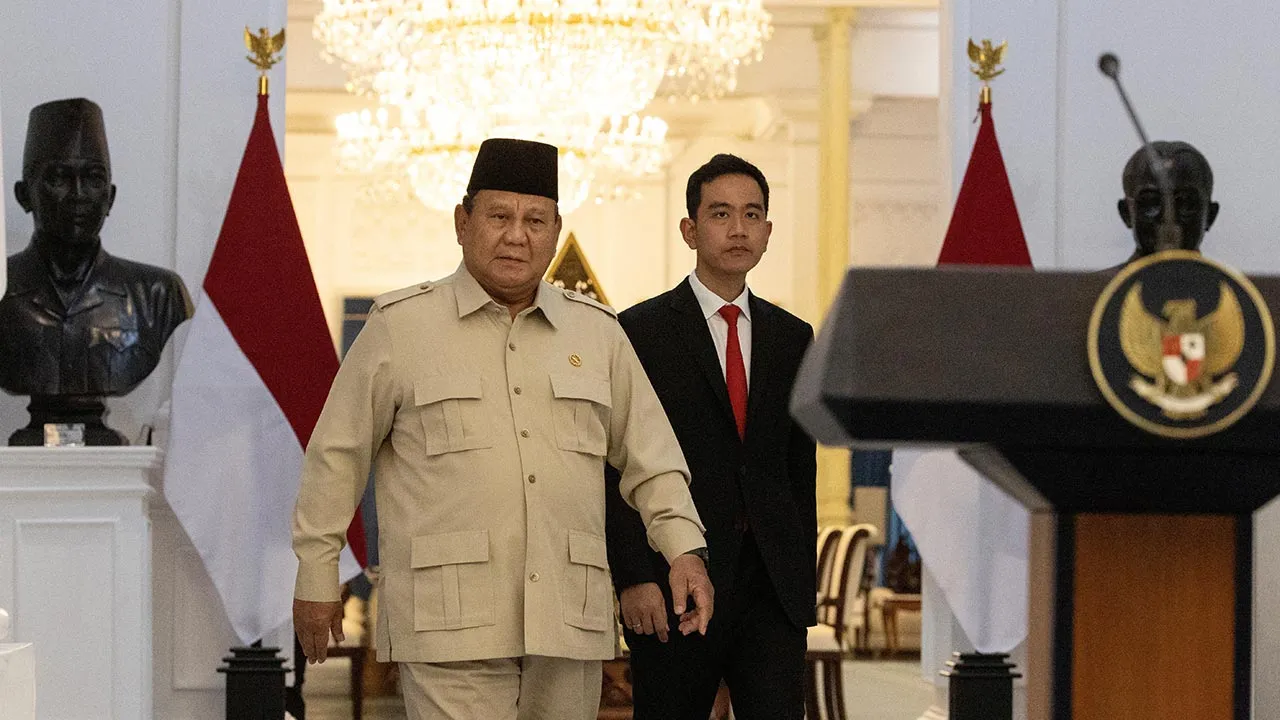
GIBRAN Rakabuming Raka’s resignation exposes the weakness of a political bargain that served both Prabowo Subianto and Joko Widodo. Prabowo gained a running mate whose family name helped associate his candidacy with continuity under Jokowi.
Jokowi’s family gained direct presence in the administration that succeeded him. Now that the arrangement has become a burden, the question is how much responsibility either man is prepared to accept for it.
On 12 November 2026, Gibran tendered his resignation to the People’s Consultative Assembly (MPR), requesting that it process his departure. His decision followed court proceedings regarding his educational credentials and mounting parliamentary pressure.
This allowed Prabowo to consolidate his authority; however, removing a politically vulnerable deputy did not resolve the institutional failures surrounding his rise.
The distinction between consolidating presidential power and restoring public accountability determines the significance of what follows.
A political failure beyond Gibran
Legal findings require precision. On 6 October, the Constitutional Court declared the challenge inadmissible because the petitioners lacked legal standing. Nevertheless, it stated that it had found no convincing evidence of an overseas qualification supporting the required senior secondary equivalency for Gibran. On 30 October, the Supreme Court invalidated the equivalency certificate that supported Gibran’s candidacy.
Neither finding establishes that Gibran’s entire educational record was fabricated. On 1 October 2025 the Management Development Institute of Singapore (MDIS) confirmed that he had completed an advanced diploma and a Bachelor of Science (Honours) in Marketing from the University of Bradford. The controversy concerns the documentary basis for meeting Indonesia’s electoral requirements. His resignation should not be treated as an admission of forgery.
In a video statement on 12 November, Gibran maintained that his resignation was unrelated to the diploma controversy and that his educational documents were complete. His explanation does not remove the need to examine the verification process.
Even with that distinction, the political failure was substantial. Parties endorsed him, and electoral authorities accepted his candidacy. Scrutiny must therefore extend to those who assessed his eligibility, rather than end with his departure.
This controversy also recalls the circumstances of his nomination. On 16 October, 2023, the Constitutional Court created an exception to the minimum candidacy age of 40 for people who held or had held elected office, allowing Gibran to run. Jokowi’s brother-in-law, Anwar Usman, was removed as chief justice on November 7, 2023, following an ethics ruling related to that decision. This episode illustrates how dynastic advancement can compromise the credibility of institutions expected to constrain it.
The age ruling and educational dispute are separate legal matters. Politically, nonetheless, both raise the same concern: whether institutions can scrutinise a powerful family without compromising their independence. Prabowo cannot plausibly stand outside this question. He chose Gibran and benefited from the arrangement.
Jokowi’s influence meets its limits
Gibran’s departure weakens Jokowi’s position, but predictions of his political disappearance would be premature. Relationships cultivated during a presidency do not dissolve when a family member leaves office. Former allies may still value his support, while officials and politicians associated with him retain interests of their own.
Nevertheless, these relationships should not be mistaken for cohesive political blocs. The incumbent president controls appointments and sets the government’s priorities. For politicians deciding where their future lies, cooperation with Prabowo may become more attractive than defending increasingly costly political baggage.
The breadth of parliamentary pressure illustrates the limits of that protection. A total of 120 legislators from all eight House factions backed a proposal to exercise the right to express an opinion, which was a possible step towards impeachment. They included members of Prabowo’s Gerindra party. This was neither a completed impeachment vote nor proof that Prabowo orchestrated Gibran’s departure.
Nevertheless, it did show that coalition membership no longer guaranteed protection.
Jokowi’s reaffirmation of support for Prabowo on 12 November leaves room for accommodation. It can also be read as a recognition that an open confrontation would carry considerable costs. His influence now partly depends on whether others continue to find his support politically useful.
The weakness of dynastic succession is exposed here. A family connection may secure access to an office, but it cannot guarantee the loyalty of parties, whose interests change based on political interests. Subsequently, Jokowi’s political legacy will be judged partly by the institutional controversies surrounding his son’s advancement, not solely by his record in the government.
Prabowo shares responsibility
For Prabowo, greater freedom from Jokowi would not necessarily produce better governance. It could allow clearer direction and firmer ministerial accountability. It could equally encourage the replacement of one network of patronage with another, more directly dependent on the president.
Therefore, a reshuffle should be assessed based on its achievements. Removing officials merely because of their association with Jokowi could provoke political retaliation. Retaining everyone in the name of stability could shelter failures that require further investigation. Responsibility must be established through evidence using standards that also apply to Prabowo’s allies, including the president.
Cabinet survival is a less demanding test than effective governance. Ministers can remain publicly loyal while delaying decisions, defending their political patrons, or avoiding commitments until their positions become more certain. A coalition may appear united even as its capacity to implement policies deteriorates.
Succession bargaining could exacerbate this problem if support is acquired through additional appointments or incompatible policy promises. The public would bear the cost through confused responsibilities, delayed implementation, or spending commitments made primarily to satisfy the coalition partners. These are risks to watch, rather than consequences already established by Gibran’s resignation.
Prabowo’s task is to give ministers clear responsibilities and hold them accountable to agreed priorities. Repeatedly renegotiating these priorities to preserve political support would weaken the authority he hopes to consolidate.
Who benefits from succession?
By the afternoon of November 12, MPR Speaker Ahmad Muzani described the vice-presidential office as vacant. Article 8(2) of the Constitution requires the MPR to elect a vice-president from two presidential nominees within 60 days of a vacancy. A fresh popular presidential election is not required.
Prabowo’s power to nominate both candidates gives him considerable influence over the election. A loyalist could strengthen presidential control, while disappointing coalition partners. A senior party figure could secure broader cooperation but acquire an independent platform. Someone acceptable to Jokowi could ease tensions while preserving elements of the existing bargain.
This choice will shape the calculations beyond the remainder of this term. Coalition parties will assess who gains national visibility and an advantage in the next presidential elections. Therefore, an orderly succession may conceal substantial bargaining over the distribution of future power.
A negotiated settlement appears more plausible than an immediate coalition breakdown. Governing parties have reasons to preserve access to office, and Jokowi has publicly supported Prabowo’s administration. This assessment would change if major partners withdrew their support or succession negotiations developed into a sustained challenge to Prabowo’s authority.
Reformasi beyond one resignation
Although Gibran’s departure creates an opening for accountability, its value depends on whether scrutiny continues after the immediate political pressure subsides. Electoral authorities should explain how these documents were verified to the public.
Parties should account for their vetting process. Judicial findings should lead to corrections in administrative practices. For Prabowo, the uncomfortable test is whether he will support scrutiny when it also reaches the people who helped bring him to power. For Jokowi, it is whether loyalty to family takes precedence over an honest reckoning with the institutions implicated in his son’s rise to power.
Twenty-eight years after Reformasi, Indonesia deserves more than a settlement among political elites. Whether citizens gain stronger safeguards against the next politically convenient exception is the more consequential question.
Rizal Hamdan is a Senior Program Officer at Merdeka Centre. He writes about geopolitics and foreign affairs for RIMAU Geopolitical Insight on Substack. The views expressed here are his own.
** The views and opinions expressed in this article are those of the author(s) and do not necessarily reflect the position of Astro AWANI.